
Why We Still Hold the Shears
They belonged to my grandfather before they belonged to my father.
And now they belong to me.
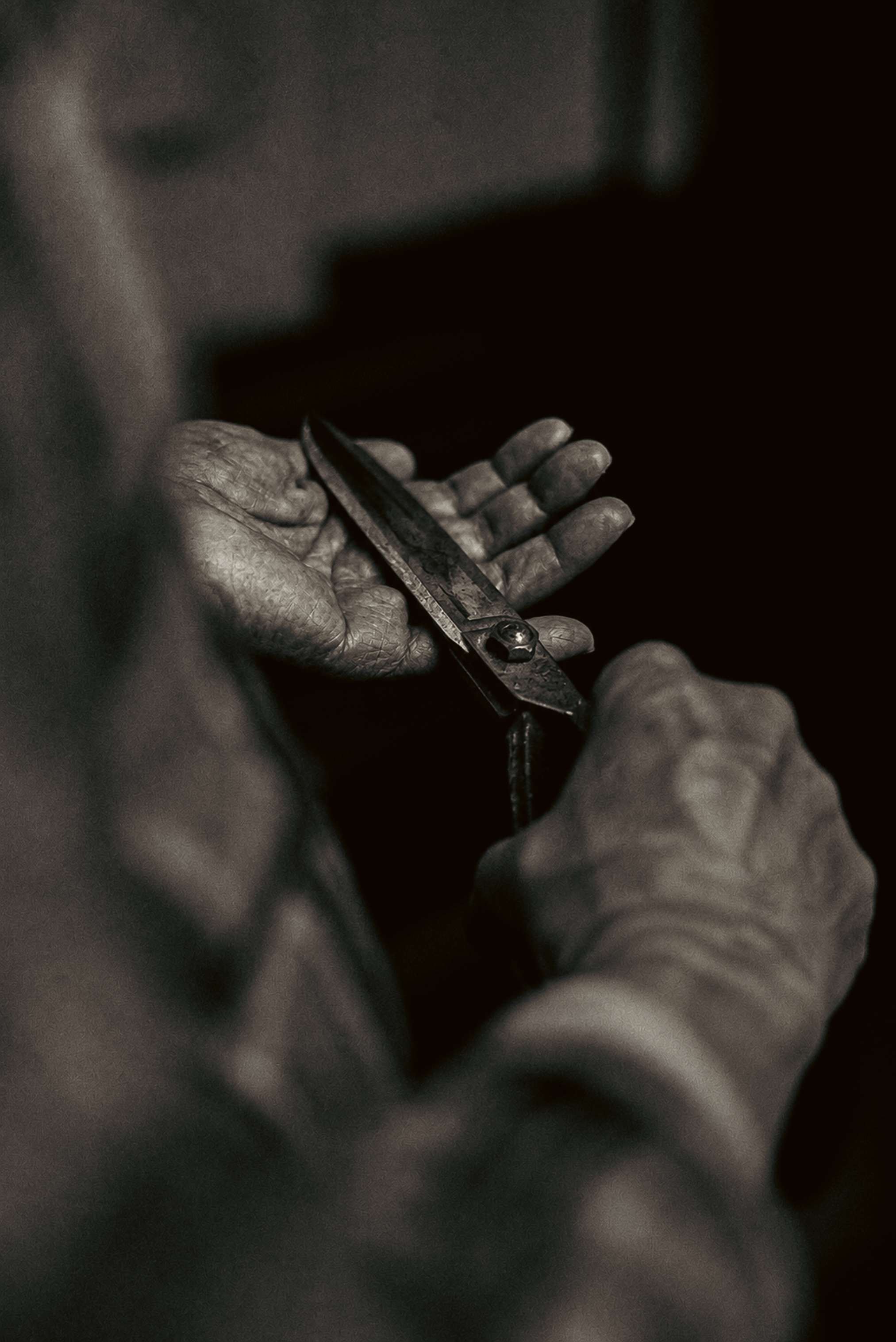
When my father retired and returned to Vietnam, he left the shears with my mother for safekeeping. They were wrapped in cloth and kept with the possessions that mattered to him.
After my father died, my mother gave them to me.
I remember their weight.
Tailoring shears are heavy by nature. They need to be. They spend their lives cutting cloth across a table.
But that isn't the weight I remember.
I remember standing there holding something that had passed from my grandfather's hands, into my father's, and finally into mine.
My father was supposed to give them to me himself.
He never had that chance.
So my mother did.
A trade can be inherited.
We often talk about family businesses as though what passes from one generation to another is a company.
A name. A shop. Customers. Equipment. Perhaps some financial value.
I have come to see it differently.
What I inherited was a responsibility.
My grandfather practised this trade. My father practised it. They supported their families through it. And through their actions, they taught that the work carried obligations beyond simply earning money.
Do the work properly.
Be accountable for what leaves your hands.
Protect your name.
Protect your trade.
My grandfather died before I really had the opportunity to know him as I wish I had. Much of what I understand about him came through my grandmother.
One thing has always remained with me.
His moral compass was uncompromising.
My father was much the same.
That did not mean pride came before feeding your family. Quite the opposite. Providing for your family sometimes requires swallowing your pride.
Their idea of honour was quieter than that.
I grew up in Australia. For much of my younger life, I probably did not recognise how deeply those values had been embedded in me.
As I have grown older, I have found myself returning to them.
Then I saw another way.
Years later, I travelled to Guangzhou.
I had originally gone with an interest in the textile trade, machinery and technology. Through that trip, I was invited to visit major clothing manufacturing operations.
What I saw genuinely impressed me.
These were not primitive factories producing crude clothing.
They were sophisticated manufacturing systems.
Digital patterns. Production planning. Automated cutting. Enormous numbers of individually ordered garments being organised and manufactured with a level of efficiency that a traditional tailoring workshop could never hope to reproduce.
I spent far longer in those factories than I had expected.
I wanted to understand how they did it.
The manufacturers saw a commercial opportunity too. There was an opportunity for Perth Tailoring Co to work with that kind of production system.
Commercially, there was a very sensible argument for doing it.
We could sell more garments.
Production could become easier.
The limitations of what a small workshop can physically produce would change enormously.
It could have been more scalable and potentially more profitable.
This isn't a story about good people and bad people.
It is about two different ways of thinking about what a tailoring house should become.
The strange thing is, I don't remember making the decision.
There should probably have been a great internal debate.
Tradition on one side. Commercial opportunity on the other.
There wasn't.
I simply knew.
We didn't do it.
Only much later did I begin asking myself why the decision had come so naturally.
Eventually my thoughts returned to an old pair of shears.
Perhaps the decision had been made long before I ever walked into those factories.
Perhaps parts of it had been made before I was born.
My grandfather had made his choices.
My father had made his.
There is a cost to holding on.
It would be dishonest to romanticise this too much.
Tradition does not pay an electricity bill simply because it is beautiful.
A workshop needs to survive.
People need wages.
Families need food on their tables.
Machinery needs maintaining. Rent needs paying. Time has a cost.
There are circumstances in which people make decisions because survival leaves them little choice.
I am fortunate.
The generations before me endured difficulties that gave me choices they did not always have themselves.
That matters to me.
It would be very easy, standing in relative comfort, to turn their struggle into a romantic story about choosing honour over money.
I will not do that.
They needed the trade to survive because their families depended upon it.
And somehow, through all of that, they preserved it.
Efficiency has a price that isn't always measured in dollars.
Modern manufacturing has achieved something extraordinary.
It has made individual choice scalable.
That deserves recognition.
But scale changes relationships.
In a traditional tailoring workshop, the person is not simply an order moving through a production system.
There is a body standing in front of you.
A cutter studies it.
A pattern is created.
Cloth is laid on a table.
The shears go through it.
A garment returns to the body.
You look again.
You correct.
You make.
You fit.
And ultimately, somebody is responsible.
That process is slow.
It is difficult to scale.
It depends upon knowledge residing in people.
From a purely commercial perspective, some of that can look terribly inefficient.
Perhaps it is.
Sometimes what disappears is the human relationship that gave the work its meaning in the first place.
We don't own the trade.
I sometimes hear Perth Tailoring Co described as my business.
Technically, of course, that is understandable.
But I don't really think about it that way.
The older I become, the less I feel that I own any of this.
I inherited knowledge from people who inherited knowledge from people before them.
Somebody taught my grandfather.
My grandfather passed the trade forward.
My father carried it.
Now, for a period of time, I carry it.
Our responsibility is not to freeze tailoring in the past.
Technology will continue to change clothing, and it should.
Our responsibility is simply to make sure that in embracing what comes next, we understand what we are choosing to leave behind.
Because once knowledge disappears from people's hands, recovering it is much harder than preserving it.
Why we still hold the shears.
I have that old pair of shears today.
I know their physical weight.
But I understand their other weight much better than I did when my mother first placed them in my hands.
They carry my grandfather.
They carry my father.
They carry years of work I never witnessed, sacrifices I will never completely understand, and lessons that were being taught to me long before I realised I was learning them.
One day, they will leave my hands too.
And perhaps that is the simplest explanation for the decision I made after seeing what modern manufacturing could offer us.
The shears were never really mine.
They belonged to the people who came before me, and for a while I have been trusted to carry them.
It is to make sure there is still a trade worth handing to whoever holds the shears after me.
We look after it for a while.