Full Bespoke
An individual pattern developed for the wearer, cloth cut in Perth and a garment developed through successive fittings.
Explore Full Bespoke ↗At Perth Tailoring Co, the tailor who meets you, measures you and understands what you are asking for is the tailor responsible for your cut.
Measurements are important. Understanding the person behind those measurements is what gives them meaning.
The way you stand, move and carry your shoulders. The relationship between your chest, waist and seat. The silhouette you want to achieve. The purpose of the garment.
These are decisions that cannot be resolved by a measuring tape alone.
At Perth Tailoring Co, our custom tailoring work is informed by the knowledge of a working tailoring house, where cutting, pattern development, fitting and garment construction are understood as connected disciplines.
The difference begins with the person interpreting the wearer.
“When people talk about going to see their tailor, they’re not. They’re actually going to see their cutter.”Kathryn Sargent · Savile Row Cutter
Choosing a custom suit in Perth can be confusing, particularly if you have never had one made before.
You may be shown hundreds of fabrics and hear about precise measurements, posture and movement assessments, individual or hand-drafted patterns, muslin fittings, multiple fittings, hand cutting, master tailors, made-to-measure and genuine bespoke.
These are all terms associated with tailoring. But hearing them does not, by itself, tell you how your garment will actually be made or who will be responsible for making it.
The distinction becomes important when a retail business presents its sales process as though it were the tailoring process. A sales consultant may discuss posture, take detailed measurements, promise an individual pattern and describe multiple fittings, while the patternmaking, cutting and making are actually performed by other people elsewhere.
In that situation, the person standing in front of you is not your cutter. They are the intermediary between you and whoever is actually making the garment.
A retail showroom is designed to present and sell garments. A working tailoring house requires something more: a physical workshop where the tailoring work it describes can actually be performed.
If the person taking your measurements is not responsible for your pattern and cut, and the premises do not contain the workshop where that work takes place, then the tailoring is being performed by somebody else, somewhere else.
That may be an interstate or overseas maker, or a separate alteration business contracted to carry out local fitting corrections. Those are retail and intermediary arrangements, and they should be described to the client for what they are.
If a business presents its salesperson as your tailor, its showroom as a tailoring house, or another maker's work as though it were being performed by the people standing in front of you, it is misrepresenting the tailoring process.
The distinction is not complicated. Either the people making the tailoring claims are doing the tailoring work, or they are not.
The client has a right to know the difference.
The easiest way to understand tailoring is to forget the terminology for a moment and look at the work behind it.
A measurement is only information. Someone still has to understand what that measurement means on your body and translate it into a pattern and eventually into cloth. Posture, balance and proportion also have to be interpreted by someone. An individual pattern has to be created by someone. Cloth described as hand-cut still requires a person holding the shears.
That person is the cutter.
In a traditional tailoring relationship, the cutter is not simply a name somewhere behind the process. They meet the client, observe the body, take and interpret the measurements, develop the pattern, cut the cloth and remain involved when the garment is fitted and corrected.
The same principle applies to the workshop.
Patterns need somewhere to be developed. Cloth needs a cutting table. Garments need to be constructed, opened, corrected, pressed and finished. These are physical processes requiring skilled people, equipment and a place in which the work can actually happen.
That is why, beneath all the terminology, a tailoring house is remarkably easy to understand.
The person interpreting the client is responsible for translating that knowledge into the pattern and cut.
The physical tailoring work has somewhere to happen, with the people and equipment required to perform it.
So when you hear master tailor, individual pattern, posture assessment, hand-cut, multiple fittings or genuine bespoke, you now know what to look for behind those words.
At Perth Tailoring Co, we would rather teach you how tailoring works than simply ask you to believe what we call ourselves.
Understanding who performs the work is only the beginning.
The next question is what kind of tailoring process the garment actually requires.
At Perth Tailoring Co we work with three custom methods: Full Bespoke, Made-to-Measure BGM and Made-to-Measure.
They are not simply three price levels. They begin differently, allow different degrees of pattern development and suit different bodies, garments and intended results.
Our responsibility is to recommend the process the wearer and garment require, not simply the most complicated one available.
An individual pattern developed for the wearer, cloth cut in Perth and a garment developed through successive fittings.
Explore Full Bespoke ↗A PTC process that combines and reshapes established pattern components around the wearer's individual geometry and intended silhouette.
Explore BGM ↗A block-based custom process for clients whose body, garment and intended result are suited to an established pattern system.
Explore Made-to-Measure ↗Before cloth is cut, we need to understand the person who will wear it.
Measurements matter. But measurements are only data.
A cutter also reads the relationships between shoulder, neck, chest, waist, seat, posture, balance and proportion, as well as the way the client naturally stands and moves.
Style belongs to the client. The tailor's responsibility is to understand how that intention can be made to work on the person wearing it.
From that understanding, an individual pattern is developed and the cloth is cut.
The garment is then fitted while it is still being made. What the cutter learns on the body returns to the workroom, where the garment and pattern can be corrected before construction progresses.
Successive fittings allow us to refine the collar, shoulders, chest structure, sleeve pitch and the way the cloth hangs on the wearer.
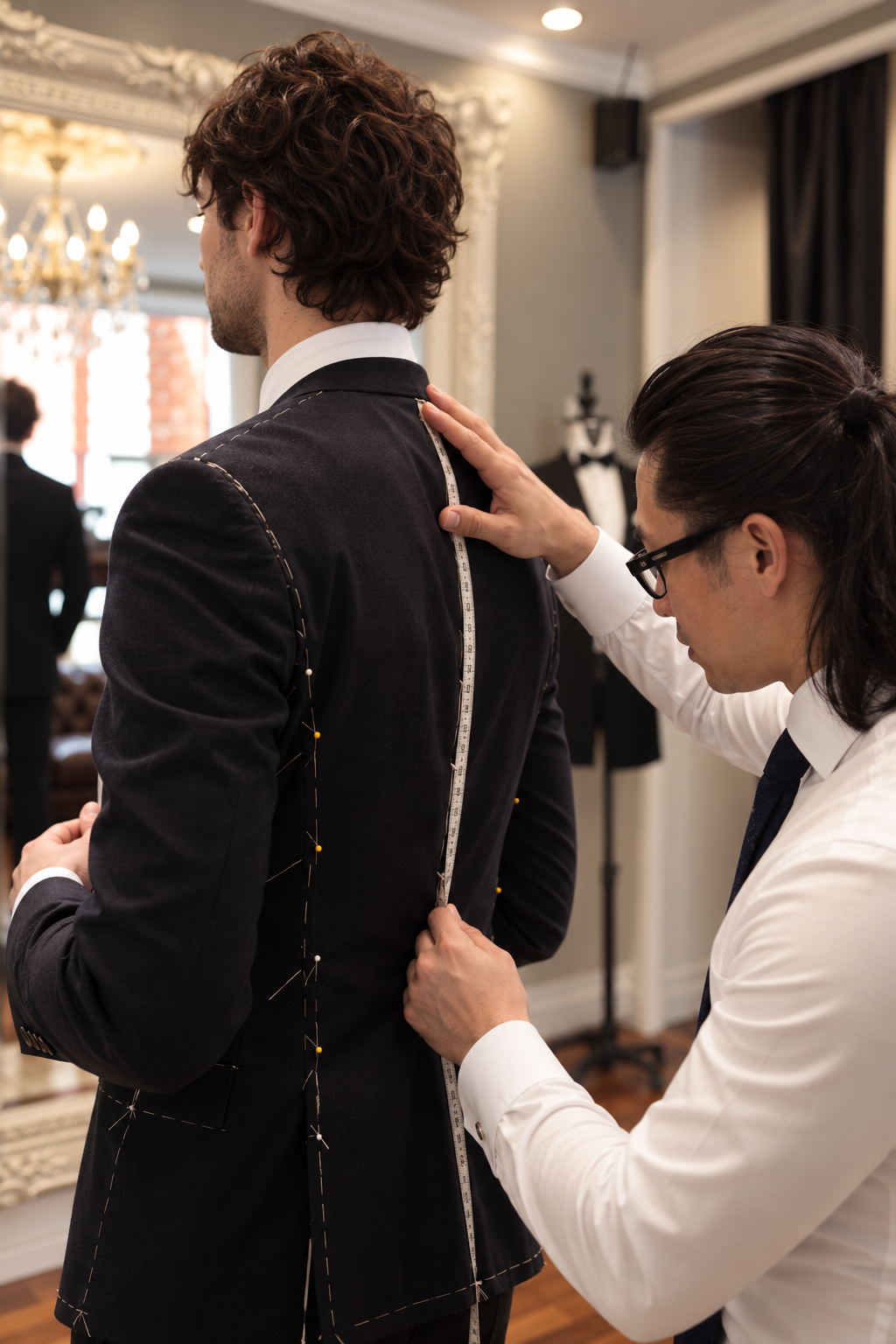
The wearer, purpose, style, body and intended result are considered before the garment is resolved.
An individual pattern is developed and the cloth is cut for that wearer.
The garment is assessed on the wearer while meaningful corrections can still be incorporated.
Cutting, fitting, correction, construction and pressing continue until the commission reaches completion.
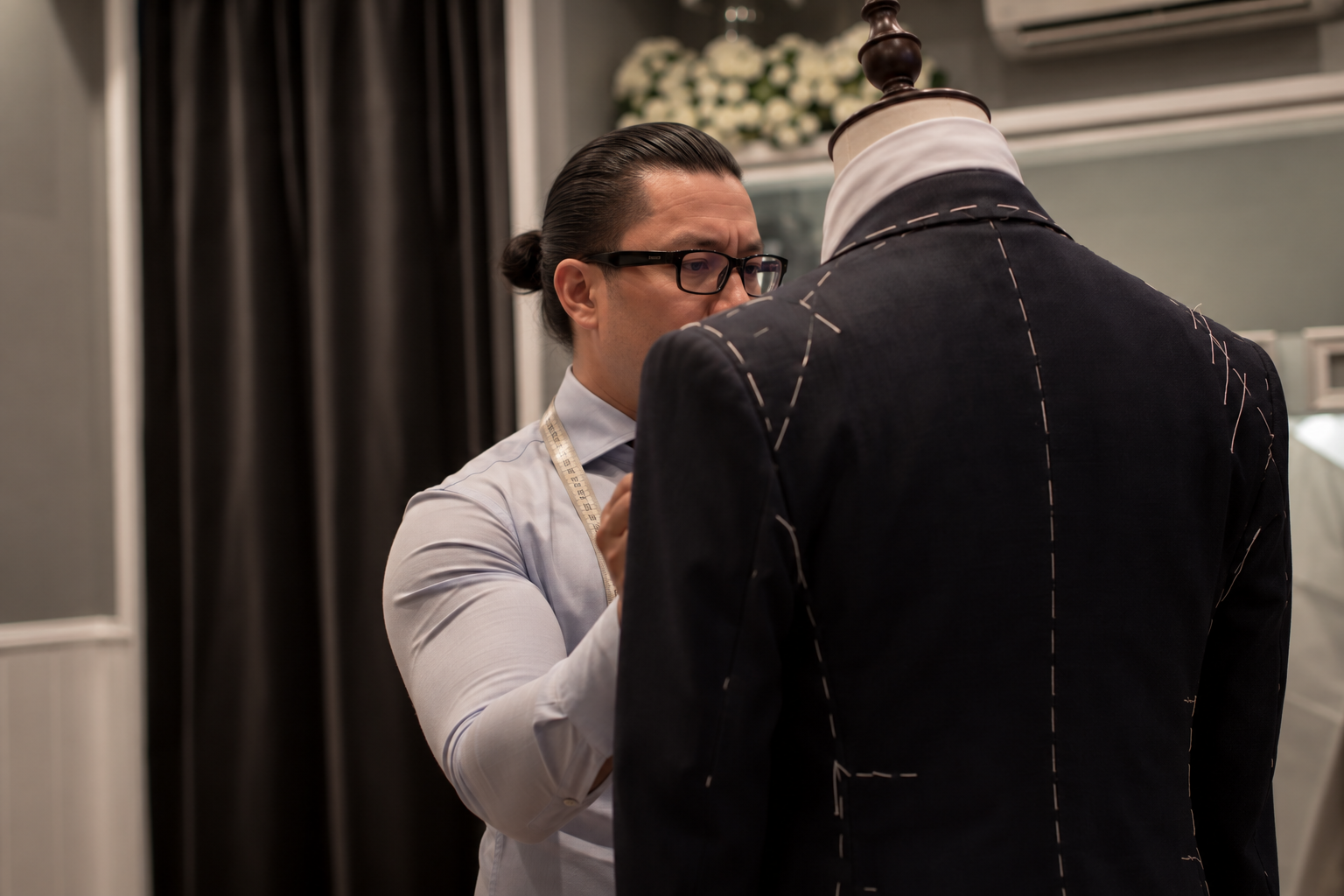
BGM stands for Body Geometry Molding.
BGM begins with established PTC pattern blocks and components, selected according to the wearer and intended design.
Rather than simply making a block larger or smaller, we can combine different pattern components and redraw their lines and proportions around the individual.
For example, a prominent abdomen may require more room through the front without unnecessarily changing the back or disturbing the intended button position and silhouette.
Length, width, angle, depth and the relationships between different parts of the garment influence how it appears on the body.
BGM allows us to develop those relationships before construction, offering greater individual shaping than conventional Made-to-Measure.
It does not offer the same freedom for successive structural correction as Full Bespoke.
Made-to-Measure adjusts an established block within its pattern system.
BGM allows us to reconstruct and reshape the starting geometry.
Full Bespoke develops an individual pattern through a more extensive cutting and fitting process.
BGM grew from two disciplines within the Pham family's working knowledge of clothing.
Traditional tailoring taught the relationship between the individual wearer, pattern, cutting, fitting, balance and correction.
The family's later apparel design and manufacturing work added another discipline: translating a design into workable pattern geometry and preserving its intended proportion across different bodies and sizes.
Those two ways of thinking meet in BGM.
Instead of treating every change as a matter of size, the pattern can be considered in terms of proportion and geometry around the individual wearer.
Fit asks whether the garment sits correctly. BGM also asks what shape the garment creates.
More complicated does not automatically mean more appropriate.
Made-to-Measure begins with an established garment block whose underlying proportions are already suitable for the client and intended garment.
The appropriate block is selected and sizing adjustments are made within that system.
For a client whose frame and requirements sit comfortably within those proportions, that can be exactly what is needed.
Where the body or intended silhouette requires more substantial changes to proportion and geometry, BGM or Full Bespoke may be more appropriate.
And sometimes the sensible advice may be simpler still: a well-chosen ready-to-wear garment followed by good alterations.
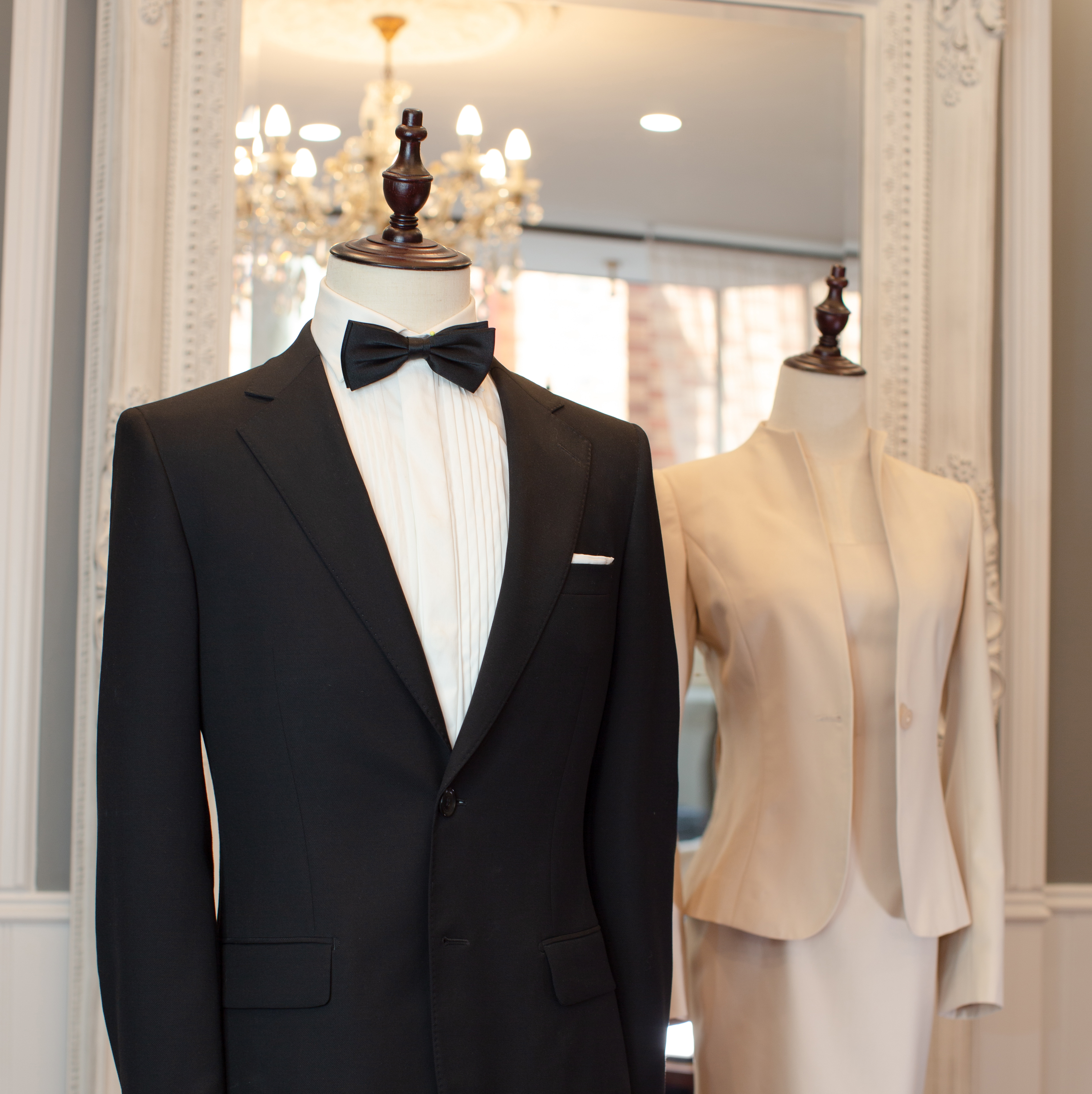
That is part of our job.
We begin with your deadline. If a method cannot be completed properly in the time available, we will not recommend it. We then consider your body geometry, the silhouette you want, how the garment will be worn and the appropriate investment.
A correctly sized suit is not always the same as a deliberately shaped silhouette. Shoulder structure, lapel roll, jacket length and trouser rise can change how the body appears.
Your style belongs to you. Our responsibility is to explain how the proportions will work together and where a design may need adjustment to achieve the intended result.
If Made-to-Measure is appropriate, we will say so. If the result requires BGM or Full Bespoke, we will explain why. Sometimes ready-to-wear with skilled alterations is the most sensible answer.
The recommendation should serve the wearer, not the price of the garment.
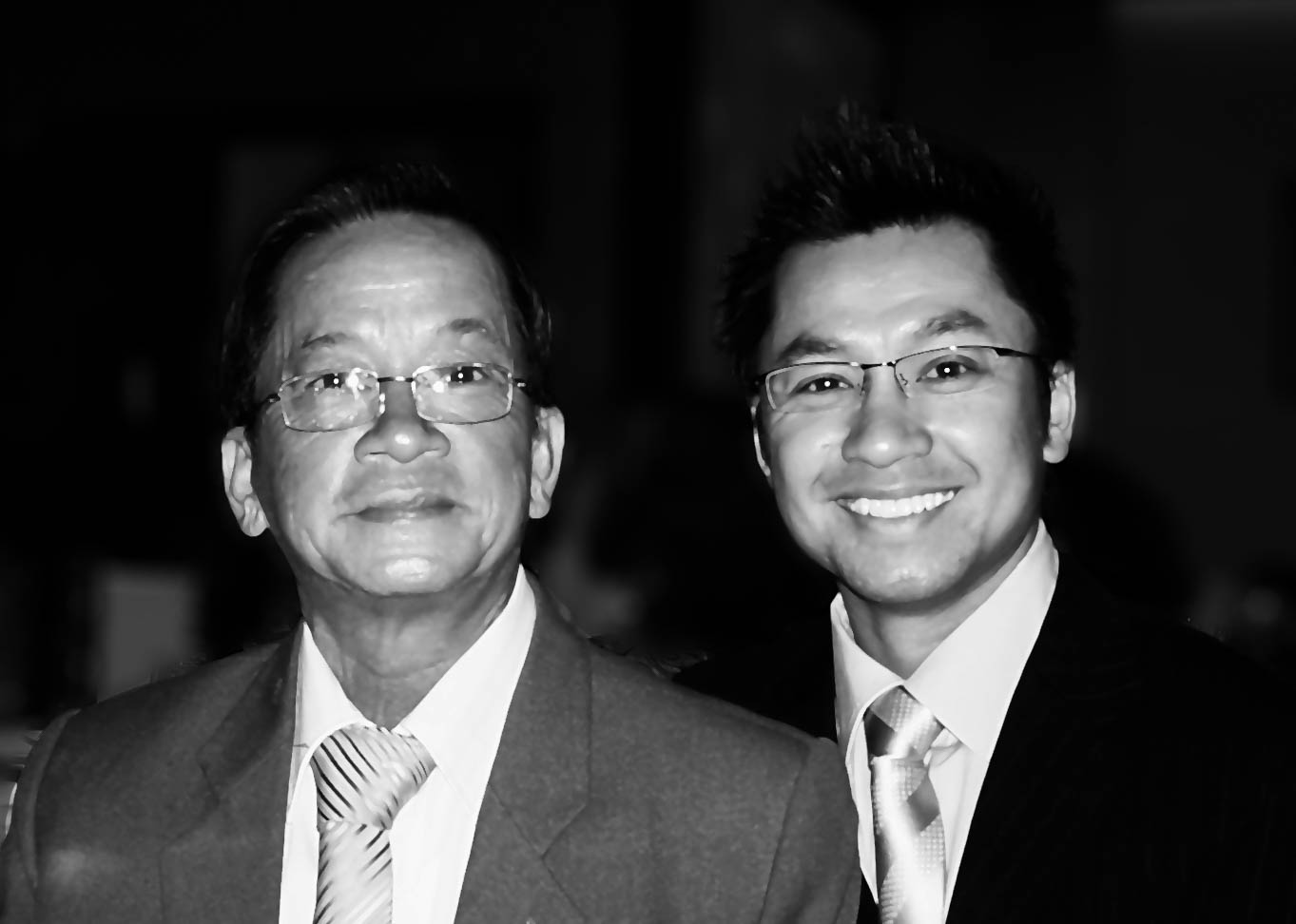
My father taught me that our name is carried through the work we leave behind, and through the trust of the people who place that work in our hands.
His words have remained with me throughout my life.
“A name is not woven from gold, but from the trust we tailor into every stitch. Measure with care, and you will be remembered with love.”
You do not need to arrive knowing whether you need Full Bespoke, BGM or Made-to-Measure.
Bring the idea, purpose, occasion and, if useful, photographs of what you have in mind.
We will look at the person first, then determine what process is appropriate.
Whether you commission a garment from Perth Tailoring Co or somewhere else, you should understand who is responsible for the work and how the garment will actually be made.
We are not asking you to trust us.
We are showing you how to verify us.