
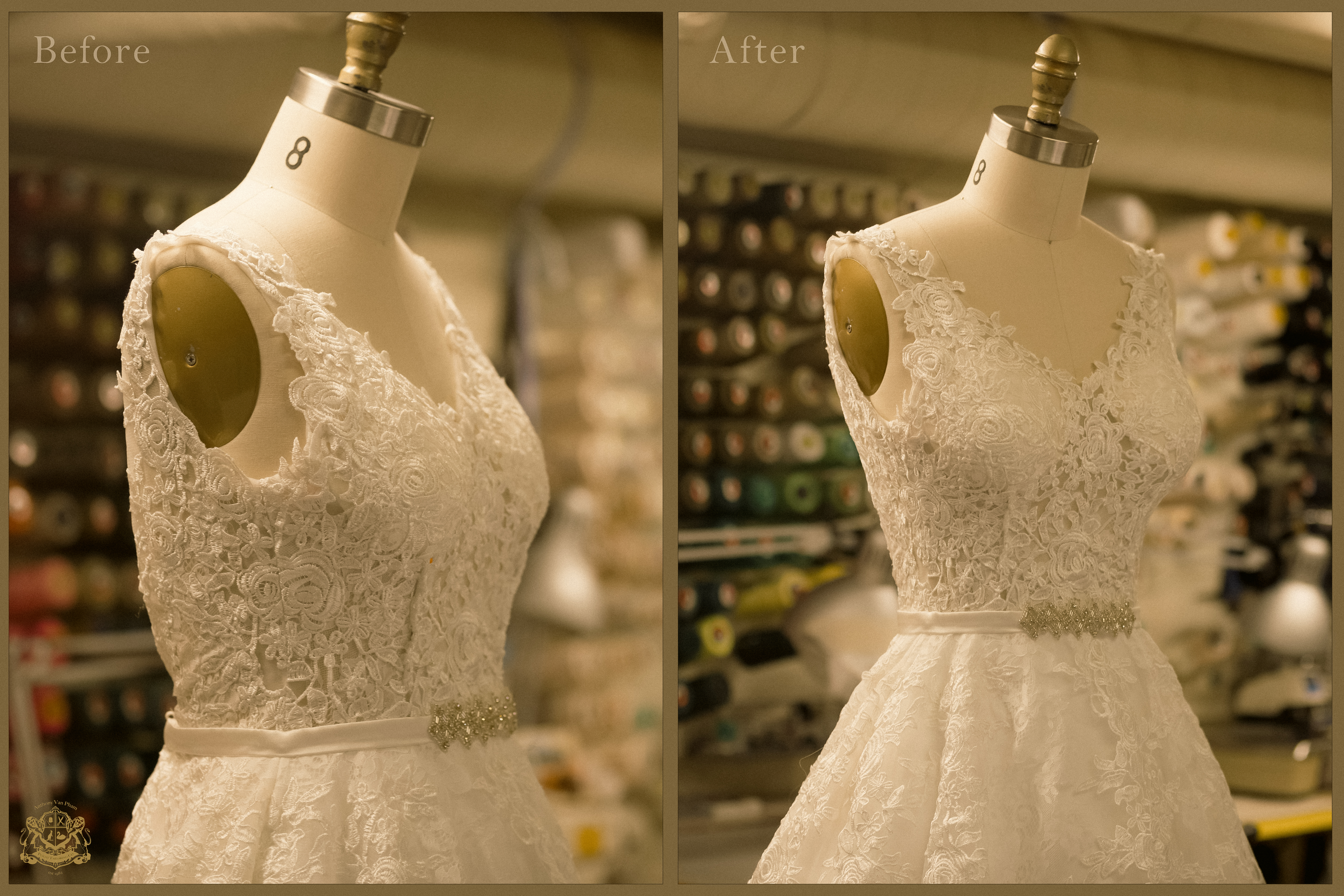
A garment can be changed with a needle and thread. Understanding what should be changed is an entirely different skill.
Most people recognise when something about their clothing doesn't look quite right.
A jacket pulls across the back. A sleeve twists. A pair of trousers gathers beneath the seat. A dress no longer falls as it was intended.
The natural response is to identify the offending area and ask for it to be altered.
But there is something I have learnt from a lifetime working with garments.
The place where a problem becomes visible is not always the place where the problem begins.
A customer standing in front of a mirror might point towards the back of a jacket and say, "Can you just take this in?"
It sounds like a simple request.
There is excess cloth. There is a seam. Surely the answer is to remove some of the excess and sew the seam closed again.
Sometimes, that is exactly the right solution.
But sometimes the apparent excess has very little to do with the circumference of the jacket.
It may be the way the garment is sitting on the shoulders. It may be the relationship between the front and back balance. It may be influenced by the wearer's posture, or by how the original pattern was cut.
Remove cloth from the wrong place and the jacket may become narrower without becoming any better fitted.
In fact, you may create another problem somewhere else.
This is why I have never regarded a good alteration as simply a sewing exercise.
The most important decision often happens before a single stitch is made.
A crease is a clue, not an instruction.
When a tailor looks at a garment, the first question should not necessarily be, "Which seam do I alter?"
It should be, "Why is the garment behaving this way?"
There is an important difference.
A crease across the back of a jacket may be telling us something about its length balance, the position of the shoulders, the shape of the back, or several elements working together.
A diagonal pull through a sleeve may be connected to the angle at which the arm naturally hangs.
Tension across the front of a jacket may involve more than the measurement of the chest. The wearer's posture, chest development, shoulder position and the garment's original construction may all be relevant.
These are not problems that can always be diagnosed by looking at a photograph or taking a single measurement.
They require an understanding of the relationship between the human body and the structure surrounding it.
This is the knowledge a pattern cutter brings to an alteration.
When you have learnt to develop the shape of a garment from the beginning, you approach problems in existing garments differently.
You begin to recognise how the pieces were intended to work together.
And more importantly, you begin to understand what happens when that relationship is disturbed.
A garment can be the correct size and still be wrong for the person.
One of the most misunderstood things about clothing is the difference between fit and balance.
Fit concerns the relationship between the dimensions of a garment and the body.
Balance concerns how the garment hangs and distributes itself around that body.
A jacket may have enough room through the chest, waist and seat, yet still appear to pull, twist or sit unevenly.
It may feel comfortable when the wearer stands still but behave differently when they walk or move their arms.
Consider two gentlemen with the same chest and waist measurements.
One stands upright, with his shoulders naturally positioned towards the back. The other carries his shoulders forward and has a more rounded upper back.
They may require the same nominal jacket size.
That does not mean the same jacket will hang correctly on both men.
The garment must accommodate the physical geometry of the individual, not merely the numbers recorded on a measuring tape.
Taking in a seam changes a dimension. Rebalancing a garment changes the relationship between its parts.
Sometimes a successful alteration requires both. Sometimes changing a dimension alone is precisely what makes the result worse.
This distinction becomes particularly important when altering tailored jackets, structured garments and clothing originally cut around a specific silhouette.
A competent assessment must consider not simply where the fabric looks loose or tight, but what is causing it to behave that way.
Change one part of a garment, and another part may respond.
A tailored garment is not a collection of unrelated seams.
It is a constructed system.
Its shoulders support the upper structure. Its front and back panels establish balance. Its sleeves follow the relationship between the arm, shoulder and armhole.
Its pockets, buttons, vents and hemline contribute to the intended proportions.
Each component has a relationship with the others.
This is especially evident when shortening a suit jacket.
To someone unfamiliar with construction, shortening a jacket may appear to be a straightforward matter of raising the bottom edge.
But consider what has already been established in the garment.
The front pockets have their positions. The buttoning point has its relationship to the waist. The vents have their original length. The entire jacket has been designed around a particular proportion.
Shorten the bottom without considering those relationships, and the pockets may appear too close to the hem.
The vents may lose their intended proportions. The jacket may look visibly shortened, even if the stitching itself is impeccable.
The alteration may be technically completed.
But the original visual balance may have been compromised.
The same principle applies to many other parts of a garment.
Sleeve length cannot always be considered independently of the sleeve's pitch and the position of the arm.
Trouser width cannot always be changed without considering the knee, seat, leg line and intended drape.
A jacket's waist cannot always be reduced without affecting the relationship between the chest, hips and balance.
Tailoring is the ability to see those relationships before making the change.
Even the simplest alteration deserves a moment of thought.
Let's take something that appears much less complicated.
A trouser hem.
Most customers understandably think of hemming as a question of length.
How much needs to come off?
But consider a pair of trousers with a pronounced taper, or a wider leg designed to fall with a particular drape.
The original designer has established a relationship between the seat, thigh, knee, leg opening and hem.
If the trousers are shortened substantially, the new hem may fall at a different point along that shape.
The opening may be wider than the original finished opening.
The way the cloth falls over the shoe may change.
The visual line between the knee and the floor may no longer look the way the wearer expected.
The correct solution might still be a straightforward hem.
Or it may require additional assessment of the leg shape and proportions.
The important thing is that the decision has been considered rather than assumed.
- The wearer: Height, posture, stance and how the trousers sit on the body.
- The intended silhouette: Straight, tapered, wide-leg or another designed shape.
- The leg proportions: The relationship between the thigh, knee and finished opening.
- The cloth: Weight, structure, drape and recovery.
- The finished length: How the hem falls over the footwear and whether the intended break is preserved.
A hem is measured in centimetres. Its success is judged in proportion.
This does not mean every trouser hem needs an elaborate fitting or a complicated reconstruction.
It means understanding when a simple alteration is sufficient and when something more needs to be considered.
That judgement is part of the trade.
The outside tells only half the story.
When I examine a garment for alteration, what I can see on the outside is only part of the assessment.
I also need to understand what exists beneath the surface.
A tailored jacket may contain canvas, interlinings, padding, carefully shaped seam allowances and internal construction that supports its silhouette.
A dress may contain delicate internal structure, linings or specialist finishing techniques.
A luxury garment may use materials and construction methods that demand particular care before a seam can safely be opened.
The original construction influences both what can be altered and how it should be approached.
Some garments contain generous seam allowances.
Others have very little cloth available beyond the existing seam.
Some internal components can be adjusted while preserving the garment's intended shape.
Others may require substantial reconstruction, with consequences for both cost and the final result.
This is why experience in cutting and constructing garments becomes valuable when altering them.
You understand not simply how to open the garment, but why it was built that way.
At Perth Tailoring Co, this understanding informs how we assess work and direct it to the appropriate specialists.
Pattern cutters, fitting specialists, makers and alteration technicians perform different but connected roles.
Their knowledge must work together.
There is no lesser dignity in the work of a skilled machinist or finisher.
Executing an alteration accurately is an important craft in its own right.
But diagnosing what should be altered and executing that alteration are not necessarily the same skill.
Both matter.
The best results depend on understanding the distinction.
The person wearing the garment is part of the process.
A garment is not made to live on a mannequin.
It is made to be worn by a person who moves, sits, walks, breathes and carries themselves in an individual way.
When I fit somebody, I want to understand more than what I see in the mirror.
I ask how the garment feels.
I want to know whether they are comfortable.
I observe how the garment responds when they move.
Sometimes I will ask them to walk. Sometimes to sit. Sometimes to raise their arms or fasten the jacket.
These movements can reveal information that a static fitting does not.
A sleeve may look correct while the arm hangs naturally, yet pull when the wearer reaches forward.
A jacket may sit beautifully while standing, yet become uncomfortable when buttoned and seated.
A pair of trousers may have a clean front line but insufficient ease for the wearer's movement.
None of these observations automatically identifies a single correction.
They tell us what needs to be investigated.
How does it feel?
Does it move naturally with you?
Is this the silhouette you wanted?
What would you like to change?
I don't ask these questions merely to be courteous.
The answers are information.
They help me understand the relationship between what I can observe as a tailor and what the customer experiences inside the garment.
Those two perspectives are not always identical.
A person may prefer more ease than another customer with the same measurements.
Somebody may favour a sharper silhouette. Another may value freedom of movement above a closely shaped appearance.
These are not simply technical decisions for the tailor to impose.
They are decisions to be understood together.
A successful fitting respects both.
Sometimes the most professional alteration is the one we decline.
This is something I believe customers deserve to understand.
Not every garment can be corrected to the result somebody hopes for.
And not every technically possible alteration is a sensible one.
There are limitations imposed by the original cutting, the available seam allowances, the cloth, the construction and the position of features that have already been made.
A jacket cannot always be reshaped into an entirely different silhouette without disturbing its original design.
A garment cannot always be made substantially larger when there is no sufficient cloth available to release.
A complex shoulder alteration may require work so extensive that the cost, risk and likely outcome need careful consideration.
Sometimes an alteration would improve one area while compromising another.
Sometimes the correction is possible but disproportionate to the value or condition of the garment.
And sometimes the original garment is simply unsuitable for the transformation being requested.
A tailor should be willing to explain these limitations.
Not because the work is difficult.
Not because the garment is inexpensive or unfamiliar.
But because the customer deserves a realistic understanding of what the work can achieve.
There is a temptation in any service business to agree with a customer's request.
Agreement can be easy.
The difficult part is explaining why the requested solution may not be the right one.
But I would rather explain a limitation before cutting into someone's clothing than apologise for a result that cannot be reversed.
In tailoring, knowing when to say no is not a failure of skill.
It is sometimes the clearest evidence of judgement.
What experience really brings to an alteration.
After decades working in tailoring, I have come to appreciate that the most valuable part of experience is not simply the ability to perform a technique.
It is knowing when that technique is appropriate.
Knowing how to take in a seam is useful.
Knowing whether taking in that seam will improve the garment is something else.
Knowing how to shorten a sleeve is a practical skill.
Understanding why the sleeve is sitting incorrectly in the first place requires another level of assessment.
Knowing how to construct a garment from the beginning helps a tailor understand its possibilities when it needs to be changed.
This does not mean every garment requires a master tailor, an elaborate consultation or an expensive reconstruction.
A straightforward alteration should remain straightforward when that is what the garment requires.
There is skill in recognising simplicity, just as there is skill in recognising complexity.
The customer's interests should determine the recommendation, not the desire to turn every job into a larger one.
At Perth Tailoring Co, we approach alterations with that responsibility in mind.
We want to understand the person, the garment and the intended result before deciding how the work should proceed.
Sometimes that leads to a simple correction.
Sometimes it requires significant technical work.
And sometimes it leads to an honest explanation that the garment should not be altered in the way requested.
These are not three different standards of service.
They are three possible outcomes of the same professional assessment.
Because the purpose of an alteration is not simply to demonstrate what a tailor can do.
It is to improve the relationship between a garment and the person wearing it.
A garment arrives in our studio with a history of its own.
Somebody designed it. Somebody cut the cloth. Somebody constructed it. And somebody chose to wear it because they saw something of themselves in it.
When we alter that garment, we are not beginning with a blank piece of paper.
We are working with decisions already made, a structure already established, and a person who has entrusted us with changing it.
That deserves more than the ability to sew.
It deserves knowledge, judgement and care.
The true measure of an alteration is not how much cloth was changed. It is how much better the garment belongs to the person wearing it.
Perth Tailoring Co.