
There is a difference between paying less and receiving value.
It is a distinction easily overlooked when purchasing clothing, and even more easily forgotten when having it altered.
A garment may have been carefully selected for its fabric, construction, fit and appearance. Perhaps it was an investment. Perhaps it was purchased for an important occasion. Or perhaps it is simply a favourite piece of clothing that has served its owner well for years.
Yet when the time comes to alter it, the decision is sometimes reduced to a surprisingly simple question.
Who can do it for the lowest price?
It is a reasonable question. Nobody wants to pay more than necessary.
But there is another question worth asking first.
And that is where the conversation becomes considerably more interesting.
The attraction of a discount
Discount vouchers are familiar throughout the retail industry.
A customer purchases clothing and receives a flyer offering a percentage off alterations at a nearby business. The arrangement appears convenient. The retailer provides a recommendation, the alteration business gains a potential customer, and the customer receives what appears to be a saving.
There is nothing inherently wrong with a referral arrangement or a genuine discount.
The important distinction is whether the offer represents genuine value.
Some commercial referral arrangements may involve advertising fees, commissions or other incentives. Others may simply be informal recommendations between businesses.
The existence of a voucher tells the customer very little about the quality of the alteration, the qualifications of the person performing it, or whether the advertised saving represents a competitive final price.
A percentage discount is only meaningful when you understand the price from which it is being deducted.
Twenty per cent off an inflated price is not necessarily better value than a straightforward price from an experienced tailor.
And even a genuinely lower price may prove expensive if the work needs to be corrected.
The real question is not how much the voucher saves. It is what the customer receives in return.
A small alteration can reveal a great deal
Consider something as ordinary as shortening a pair of trousers.
To the customer, the request sounds simple.
The trousers are too long. The hem needs to be raised.
But a tailor sees considerably more.
We consider the fabric, the existing construction, the intended finish, the relationship between the trouser leg and the shoe, and how the garment falls when the wearer stands and moves.
The original hem may need to be preserved. A particular fabric may require a different stitching method. The thread must be appropriate, not merely close enough in colour. The finish should complement the garment rather than draw attention to the alteration.
Even pressing matters.
An incorrectly pressed hem can leave an unwanted impression on the fabric. Poorly controlled stitching can distort the edge. Excessive tension can cause puckering, while an unsuitable thread or finishing method can compromise the appearance of an otherwise well-made garment.
These are not extravagant details reserved for expensive clothing.
They are fundamentals of competent workmanship.
And they are precisely the details that can distinguish an alteration performed with care from one completed simply to move the next garment through the workshop.
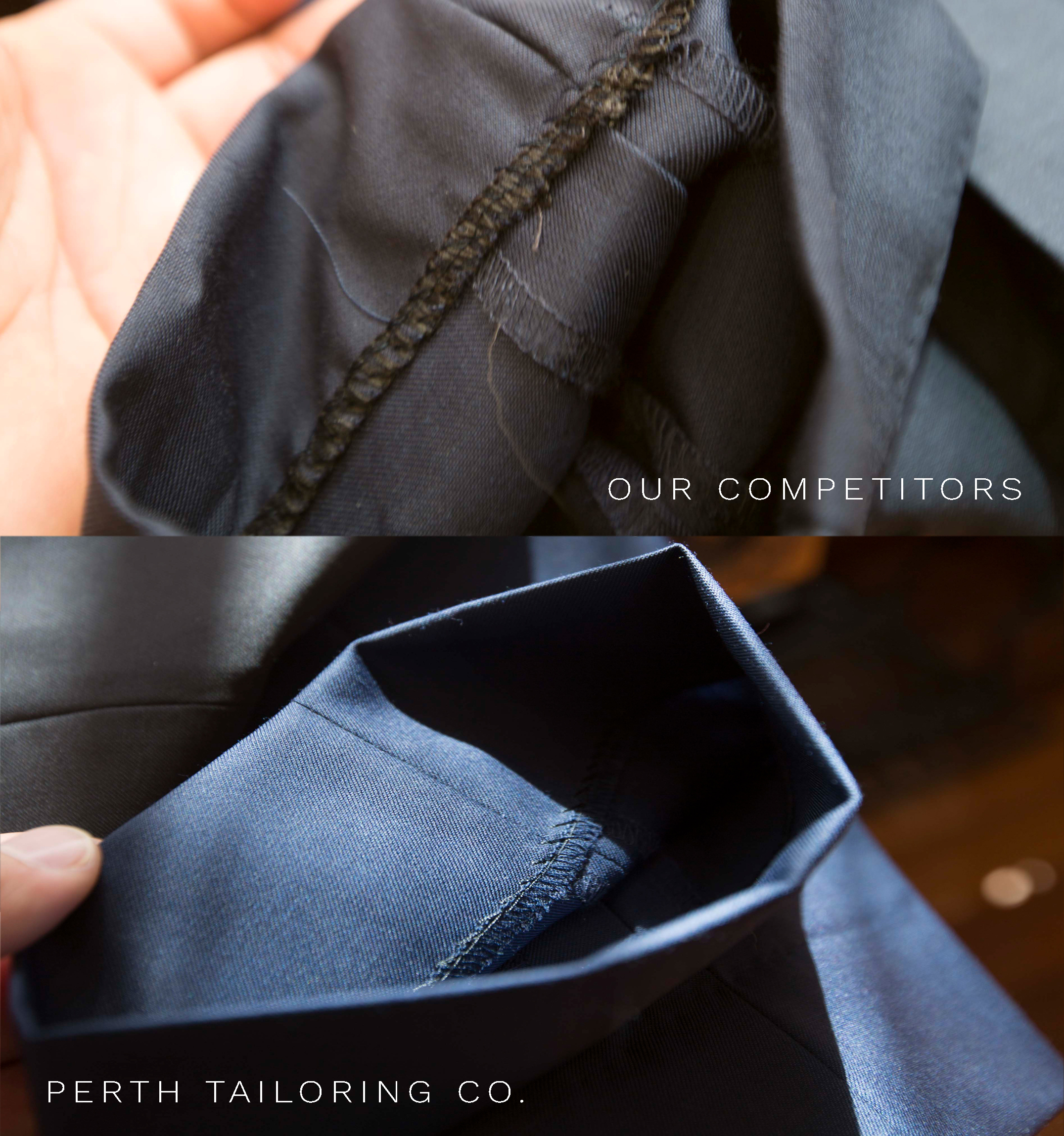
Two hems. Two very different results.
The photographs accompanying this article show a comparison from our tailoring work.
The first illustrates a poorly executed finish. The second shows the garment after corrective work by Perth Tailoring Co.
At first glance, both might be described as a completed hem.
But look more closely.
The first finish raises questions about stitching consistency, thread selection and the overall neatness of the work. The corrected finish demonstrates the importance of controlled stitching, appropriate materials and careful finishing.
The difference is not simply cosmetic.
An alteration should respect the garment's original construction and appearance. Ideally, the work should integrate naturally with the clothing rather than announce that something has been changed.
A properly finished hem should look as though it belongs there.
This is one of the quiet disciplines of tailoring.
The better the work, the less attention it often attracts.
And yet achieving that result requires knowledge, judgement and time.
The true cost of getting it wrong
When an alteration is poorly executed, the initial price is only part of the story.
There may be the inconvenience of returning to the business, explaining the problem and waiting for further work.
There may be an additional charge to have another tailor correct the alteration.
Sometimes the garment must be unpicked, remeasured, restitched and pressed.
In more serious cases, the original alteration may have removed too much material, damaged the fabric or left insufficient allowance for a satisfactory correction.
Not every mistake can be reversed.
This is particularly important with expensive or delicate garments, where a seemingly minor intervention can have lasting consequences.
A lower initial price offers little comfort when the garment can no longer be restored to the standard its owner expected.
That does not mean expensive alterations are automatically better.
Price alone is not proof of competence.
It means that the cost of an alteration should be considered alongside the quality of the work, the suitability of the method and the risk to the garment itself.
The cheapest service is not always the most economical.
And the most expensive service is not necessarily the most appropriate.
Good value lies in the relationship between the work required, the expertise applied and the result achieved.
Who is actually working on your garment?
There is another question customers rarely think to ask.
Who will perform the alteration?
A retail counter, an attractive showroom or a persuasive salesperson can create confidence. But none of these things, by themselves, establishes the technical capability of the person who will work on the garment.
Clothing alterations vary enormously in complexity.
Shortening a straightforward trouser hem is not the same undertaking as correcting jacket balance, reshaping a shoulder, adjusting sleeve pitch or altering a structured garment without compromising its construction.
Different work requires different knowledge.
Some alterations can be completed competently by an experienced machinist. Others require the judgement of a trained tailor who understands cutting, garment geometry, construction and fitting.
These distinctions matter.
At Perth Tailoring Co., our approach begins with understanding the garment before recommending what should be done to it.
We consider the existing construction, the wearer's frame, the intended result and the limitations of the garment.
Sometimes the appropriate solution is straightforward.
Sometimes it requires considerable work.
And sometimes the most responsible recommendation is not to alter the garment at all.
What experience teaches you to notice
Perth Tailoring Co. was established in Perth in 1982.
Across decades of tailoring and alterations, our workshop has encountered garments of vastly different quality, construction, age and condition.
Some arrive for ordinary adjustments.
Others arrive after alterations performed elsewhere have failed to achieve the result their owners expected.
We have seen mismatched threads, uneven hems, distorted seams, poor finishing and alterations that have overlooked the relationship between the garment and the body wearing it.
But the purpose of examining these problems is not to condemn another business.
It is to understand what went wrong and determine whether the garment can be corrected.
A responsible tailor should be able to explain the problem, identify the available options and give the customer a realistic assessment of the likely result.
That conversation is part of the service.
So is recognising the difference between a garment that needs a simple adjustment and one that requires more substantial reconstruction.
The customer should understand what is being recommended and why.
Because genuine expertise is not demonstrated by making every alteration sound complicated.
It is demonstrated by understanding the work well enough to make the appropriate decision.
Five questions worth asking before leaving your clothing
Before accepting an alteration quote, particularly for a valuable or technically complex garment, consider asking:
- Who will actually perform the alteration? Is the work being undertaken by someone experienced in the type of garment involved?
- What exactly will be changed? A good explanation should describe the proposed work in language you can understand.
- Will the original construction and finish be respected? The appropriate method depends on the garment, its materials and the result being sought.
- What are the limitations? An experienced professional should be prepared to explain what can and cannot reasonably be achieved.
- What is the complete price? Compare the actual work and final cost, rather than relying solely on a promotional percentage.
These are reasonable questions.
A competent professional should welcome them.
They demonstrate that the customer values the garment and wants to make an informed decision.
The value of work you may never notice
There is something rather satisfying about a beautifully executed alteration.
A trouser hem falls naturally.
A jacket sits more comfortably.
A seam follows the intended line.
The garment looks balanced, considered and appropriate for the person wearing it.
Nothing appears forced.
Nothing draws unnecessary attention.
The customer simply puts the garment on and feels that it is right.
Behind that result may be years of accumulated experience, a trained eye, careful measurement, appropriate construction methods and the patience to finish the work properly.
Not all of that knowledge is visible.
But its effect is.
At Perth Tailoring Co., we believe customers deserve to understand the work being undertaken on their clothing, the reasoning behind our recommendations and the value of having it done properly.
We do not believe a promotional voucher should be the deciding factor in choosing who works on a garment.
Nor do we believe that the highest price automatically guarantees the finest workmanship.
We believe the work itself should justify the price.
And that the advice given should always serve the customer's interests.