
These are not simply words used to make a suit sound expensive. They describe people, skills, construction methods and different ways of producing a garment.
For somebody who does not regularly buy tailored clothing, however, the language can make very different products sound remarkably similar.
That matters.
A client can spend thousands of dollars believing they are commissioning bespoke tailoring when the process behind the garment may actually be made-to-measure, factory production, or another form of custom clothing.
There is nothing inherently wrong with any of those methods when they are described accurately.
The problem begins when the language tells the client one thing and the process tells a different story.
First, understand what a tailor actually does.
Selling tailored clothing and practising the tailoring trade are not the same occupation.
A salesperson may know cloth. A stylist may understand colour and proportion. A consultant may have years of experience helping clients choose garments.
Those are legitimate skills and legitimate occupations.
But they do not, by themselves, make somebody a tailor.
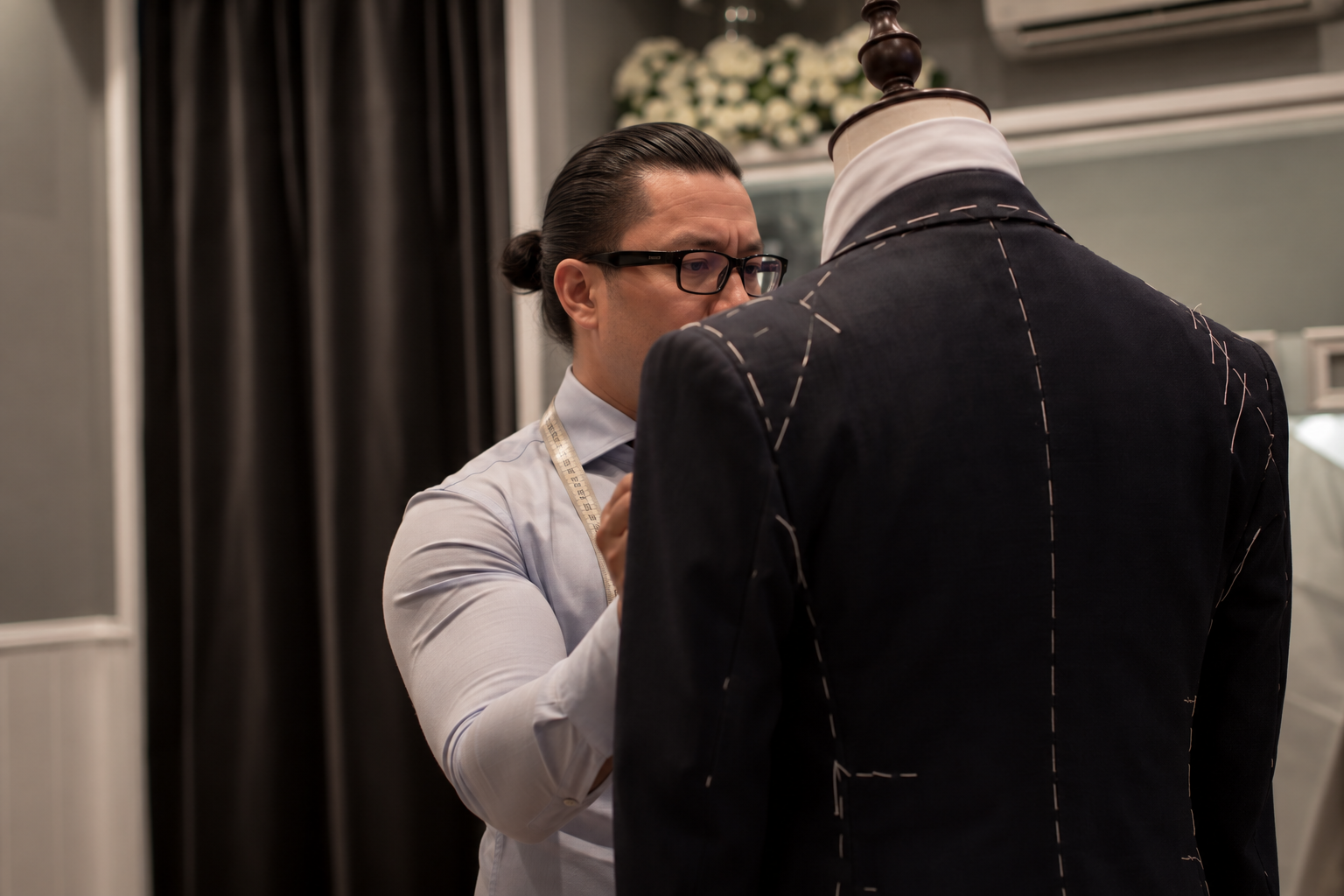
Tailoring is a practical trade. It involves the technical skills required to create, fit, alter or construct tailored garments. Within a traditional tailoring house, different specialists may perform different parts of that work: cutters, coat makers, trouser makers, waistcoat makers and finishers.
They do not all perform the same job.
But there is actual tailoring behind the title.
In traditional bespoke, the cutter is not simply taking measurements.
This is one of the most important distinctions for a client to understand.
A bespoke cutter does not stand in front of you merely to collect a chest, waist and sleeve measurement and send those numbers somewhere else.
The cutter studies the person.
Posture. Shoulder height. Balance. Stance. Chest. Back. Seat. Proportion. The relationship between the body and the garment that is going to be created.
Those observations become part of the client's individual pattern.
The cutter then uses that pattern to cut the cloth and remains responsible for interpreting the garment during fittings as it develops.
This is why the relationship between the client and cutter matters.
Taking measurements for an order is not the same thing as cutting a bespoke garment.
If the person measuring you is simply recording information for a factory or another production system, ask who is actually creating the pattern and who is cutting your cloth.
If the answer is somebody else, somewhere else, understand that distinction before accepting the description being used for the garment.
Traditional bespoke houses make this relationship remarkably clear. The cutter measures the client, creates the individual pattern, cuts the cloth and conducts the technical fittings.
Made-to-measure is not bespoke, and it does not need to be.
Made-to-measure is a legitimate and established way of producing tailored clothing.
It generally begins with an existing pattern, block or manufacturing system. The client's measurements and fitting information are used to modify that system before the garment is produced.
Depending on the maker, those modifications can be extensive and the finished garment can be excellent.
Many respected clothing houses openly describe these services as made-to-measure because that is what they are.
There is no embarrassment in the term.
The important distinction is that modifying an established production pattern is not the same process as a cutter drafting an individual bespoke pattern for one client and cutting the cloth from it.
And overseas manufacture is not the problem.
Excellent clothing is manufactured all over the world.
A garment made in Italy, England, Japan, China, Portugal or Australia should be judged on what it actually is, how it is made and whether it has been represented accurately.
The issue is transparency.
If your measurements are taken in Perth and sent to an overseas factory where an existing block or production pattern is modified, the client should be able to understand that this is the production system being used.
Calling that process made-to-measure does not diminish it.
But the client should not be encouraged to believe that the person standing in the showroom has personally drafted and cut an individual bespoke pattern if that work did not occur.
Nor should words such as “hand-made”, “canvas”, “muslin” or “custom” be allowed to obscure the basic question:
Before paying for bespoke, ask to understand the workshop.
Bespoke tailoring is physical work.
Patterns need somewhere to be drafted and stored. Cloth needs a cutting surface. Garments need to be assembled, fitted, opened, corrected, pressed and finished. Tailoring tools, machinery, irons, benches, patterns, cloth and work in progress exist because garments are actually being made.
A workshop does not need to be glamorous.
In fact, many genuine tailoring workshops are working spaces rather than showrooms.
And not every specialist maker necessarily needs to work in the same room. Traditional tailoring has always involved different craftspeople.
But if a business is selling you a bespoke process, it should be able to explain where that tailoring process actually occurs and who performs it.
These are not hostile questions.
They are reasonable questions from somebody being asked to pay bespoke prices for bespoke work.
Learn to recognise an answer that does not answer the question.
You ask who cuts your pattern and are given a speech about experience.
Years spent selling suits may represent valuable experience, but they do not answer the question. Ask again: who drafts my individual pattern and who cuts my cloth?
You ask where the garment is made and the answer becomes vague.
Overseas production is not something that needs to be hidden. A straightforward business should be able to tell you where each important stage occurs.
Technical terminology replaces a description of the process.
Muslin fittings, canvas, hand stitching and basted fittings are real things. None of them, individually, proves that an individual bespoke pattern has been drafted and cut for you.
You cannot establish who is technically responsible for the garment.
Somebody must interpret the figure, control the pattern and diagnose fitting problems. If nobody can tell you who that person is, you still do not know what process you are buying.
You are told that choosing enough options makes the garment bespoke.
Buttons, linings, lapels, pockets, cloth and styling choices can personalise a garment. They do not determine how the underlying pattern was created.
Why are we being so particular about words?
Because consumers have been misled about clothing before.
This is not an imaginary concern and it is not simply an argument between tailors about terminology.
Australia's consumer laws prohibit businesses from making false or misleading representations about goods and services.
And Perth has its own documented history showing why accurate descriptions matter.
Platinum Menswear and country-of-origin representations.
In 2007 the Australian Competition and Consumer Commission took action concerning advertising by Platinum Menswear in Perth and Melbourne.
The ACCC said advertisements for a Studio Italia suit promotion represented the suits as Australian-made even though a number of the suits offered during the promotion had been made in China.
Platinum Menswear acknowledged that the advertisements were incorrect and provided court-enforceable undertakings.
Those undertakings included corrective advertising, refunds for affected customers, compliance training and measures intended to prevent similar problems occurring again.
WA Consumer Protection publicly warned consumers about another tailoring business.
In 2015 Western Australian Consumer Protection publicly named Joseph Anthony Bespoke after receiving 24 complaints from customers involving high-end clothing they said they had paid for but had not received.
That was a different business and a different type of consumer problem.
But both cases demonstrate something worth remembering: when substantial money is being paid for clothing, what a business represents to the customer matters.
These historical cases do not prove anything about another tailoring business operating today.
They do demonstrate why consumers should not feel embarrassed about asking direct questions before paying substantial deposits or commissioning expensive clothing.
You should know what your money is paying for.
A client should not need to become a tailor before buying a suit.
That is precisely why the business has a responsibility to explain the process clearly.
If it is made-to-measure, say made-to-measure.
If an established block is being altered, explain that.
If the garment is being manufactured overseas, explain where.
If specialist makers outside the premises are involved, explain their role.
If an individual pattern is being drafted by a cutter and the cloth is being cut from that pattern, show the client what that means.
None of those explanations diminishes a good garment.
They allow the client to compare like with like.
Our advice is simple.
Do not be intimidated by tailoring language.
Do not assume a beautiful showroom proves that tailoring happens there.
Do not assume years selling suits are the same thing as years practising the tailoring trade.
Do not assume an expensive cloth makes the garment bespoke.
And do not assume that hearing words such as canvas, hand-made, muslin or custom tells you how the pattern was actually created.
Ask to understand the process.
A genuine professional should be capable of explaining it without hiding behind terminology.
See the workshop.
Ask where your pattern is created.
Ask where your cloth is cut.
Ask who will fit the garment.
Understand what you are buying.
If you are commissioning bespoke tailoring, those questions go to the heart of what bespoke actually is.
If the answers show that you are actually buying made-to-measure, that does not automatically make it a bad garment.
It simply means you now know what you are paying for.
And that knowledge should belong to the client before the money changes hands, not afterwards.
After a lifetime in the trade, my view of bespoke has become remarkably simple.
If I measure you, I need to understand the person standing in front of me.
I am looking at more than numbers. I am looking at your posture, your shoulders, your balance, the shape of your back, the way you stand and the way you move.
I cannot adequately describe all of that to somebody thousands of kilometres away and expect them to see what I saw.
That is why, in the tradition of bespoke tailoring I was trained in, the relationship between the client and the cutter is fundamental.
I measure you because I am going to create and control your pattern. I cut your cloth because I have seen and understood the body that cloth has to fit. I baste and fit the garment because I need to see whether what I observed has translated correctly into cloth.
For me, therefore, there are two very simple questions a client can ask when somebody offers them bespoke tailoring.
I would want clear answers to both.
If the person measuring you does not cut your cloth, or cannot clearly show you where the tailoring work takes place, then whatever manufacturing system is being offered may still produce a very good garment, but I would not describe that process as the bespoke tailoring I know and practise.
It makes no difference to me whether the garment is ultimately associated with Italy, France, England, China or anywhere else. This is not an argument about countries. It is about the relationship between the client, the cutter and the cloth.
The person who studies your body should be the person responsible for translating it into the pattern and cutting the cloth.
That is why my advice to anyone commissioning bespoke is simple:
Ask to see the workshop.
If you cannot get a clear answer to both questions, do not let terminology answer them for you.
Anthony Van Pham
Cutter · Perth Tailoring Co
Good tailoring advice should still be useful to you, even if you decide not to become our client.
Perth Tailoring Co
Established 1982 · Perth, Western Australia