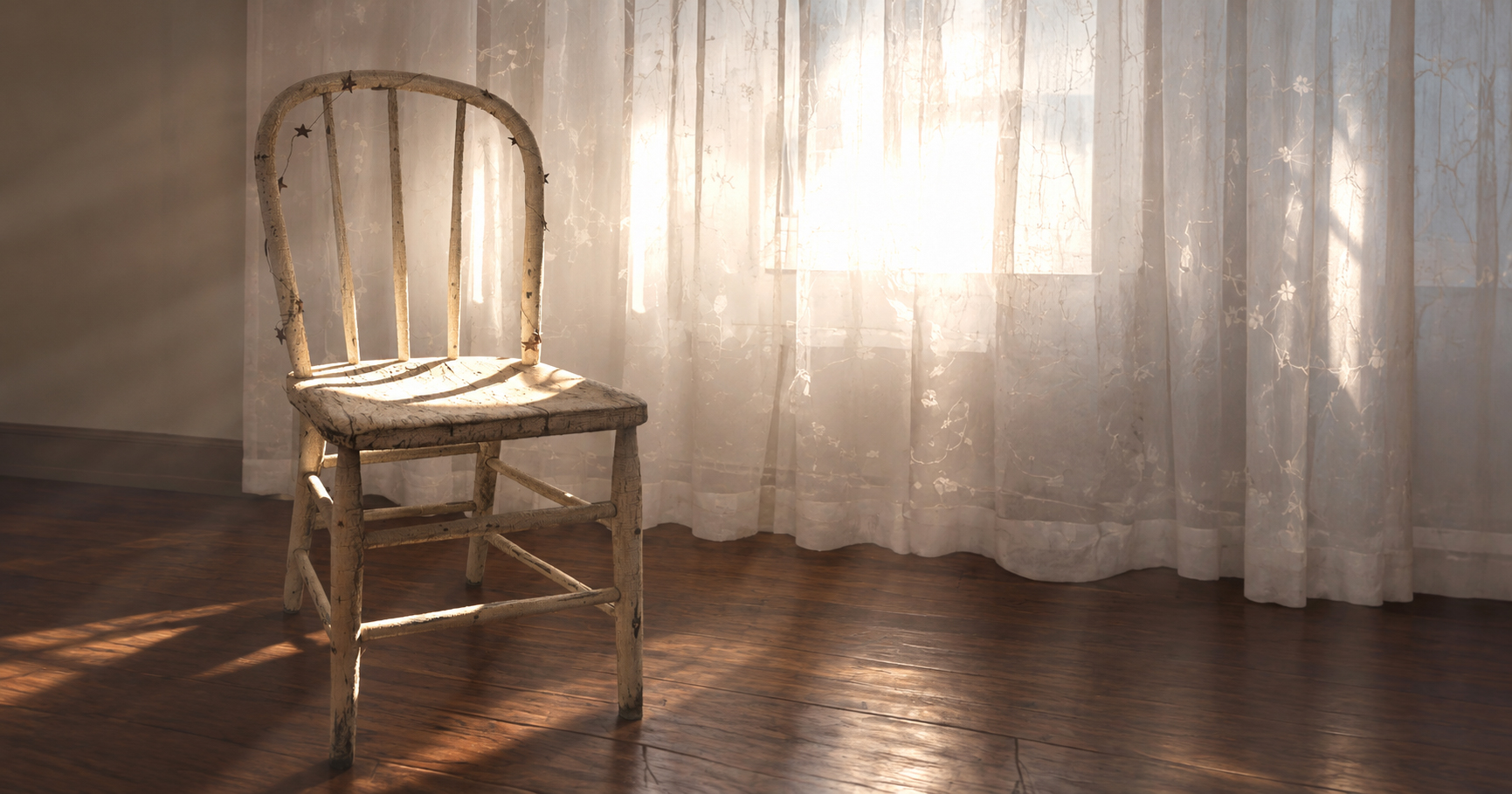
For a long time after my father passed away, I kept looking towards the same corner of our tailoring studio.
It was where he used to sit.
There was an old chair, worn and shaped by the years he had spent in it. He would sit there hand-stitching buttonholes, basting garments, working quietly with a needle and thread.
Sometimes he would tell me stories about his customers.
Not particularly remarkable stories, at least not to me at the time. They were simply the conversations of a tailor who had spent much of his life getting to know the people he dressed.
But after he was gone, I began to understand just how remarkable those stories really were.
I would look towards his corner, almost expecting him to still be there.
I think the other tailors understood. Everyone knew it was Dad's chair. Nobody was to sit in it.
Eventually, I brought it home.
Not because I needed another chair. I simply couldn't bear the thought of somebody else sitting in his place.
It was his chair. Over the years, even the shape of it had become his.
And somehow, that ordinary old chair had become one of the most precious things he left behind.
I sometimes wonder whether, if I have a child who follows me into this trade, they might one day feel the same way about mine.
Because that is something tailoring teaches you.
The things we leave behind are not always the things we imagined would matter.
The stories inside a tailoring house
Upstairs at Perth Tailoring Co, we have a large cutting table.
Behind it are racks filled with paper patterns. Some have been there since before I began my apprenticeship. Others belonged to my father's working years.
To someone walking into that room, they might appear to be an extraordinary collection of old paper.
To me, they are something else entirely.
They are people's lives.
Each individual bespoke pattern belongs to someone. Each has a history. Alongside them are measurement records that allow us to follow the changes in a person's body over successive commissions.
Some of those records stretch back through decades of tailoring.
I now work with families whose grandfathers and fathers were dressed by my father.
Sometimes I find myself fitting a son while remembering the work my father did for his grandfather.
Three generations of a family, each with their own life, their own experiences, and their own reasons for coming to us.
A young man becomes a husband.
A husband becomes a father.
A father becomes a grandfather.
And somewhere along the way, he returns to the tailor.
His measurements have changed. His posture may be different. His shoulders may not sit quite as they once did.
But what interests me most is not simply how his body has changed.
It is how his life has changed.
Because there is nearly always a story behind the next garment.
And the longer I work in this trade, the more I realise that these are the stories my father was telling me all those years ago.
What my father understood
My father knew his customers extraordinarily well.
He knew their families. He knew about their marriages, their children, their achievements and their difficulties.
And he listened.
While his hands were occupied with the garment, his customers would talk.
Perhaps there is something about sitting with a tailor that encourages this.
You are entrusting another person with something very personal. You are asking them to understand your body, how you carry yourself, how you wish to be seen.
And often, you are telling them why the occasion matters.
My father understood that the garment was only one part of the commission.
The other part was the person who would wear it.
When I was younger, I was concerned with learning the trade. How to cut, how to shape cloth, how to understand the balance of a garment.
Those things mattered enormously, and they still do.
But it has taken years of working with my own customers to appreciate another part of his teaching.
The privilege of being trusted.
My father had words of wisdom that still breathe within our studio.
"A name is not woven from gold, but from the trust we tailored in every stitch."
"Measure with care, and you'll be remembered with love."
The words of my father
I have thought about those words many times.
When you're young, it's easy to understand them as advice about workmanship. Be careful. Be responsible. Take pride in what you make.
But the older I become, the more I realise that they mean something far greater.
A good name is not something you can purchase, inherit without responsibility, or manufacture through appearances.
It is something other people entrust to you.
And every time they return, they give you the opportunity to earn it again.
The moments that never come twice
People come to a tailoring house for all kinds of reasons.
Sometimes it is for a wedding.
I have always found something beautiful about the idea of making a garment for a man who is preparing to stand beside the person he has chosen to spend his life with.
Think about that for a moment.
Out of all the days he will live, there is one particular day he is preparing for.
One day when he will stand there, perhaps nervous, perhaps overwhelmed, hoping everything will be perfect.
And he has invited us to create something that will accompany him through it.
Other times, the occasion might be a professional achievement.
A new career. A promotion. A milestone that took years of sacrifice to reach.
Sometimes a customer wants to celebrate the person they have become.
Sometimes they are preparing for a moment that requires courage rather than celebration.
And sometimes, they are saying goodbye.
Not every important occasion in life is a happy one.
There are moments of grief, of loss, of profound change.
In those moments, what someone wears can be an expression of dignity, respect or simply the strength needed to face the day.
As tailors, we do not always know the full significance of what we are being asked to make.
But when someone chooses to share that significance with us, I believe we have a responsibility to honour it.
It doesn't matter whether the occasion seems grand or modest to somebody else.
A person's life is their own.
Their happiness is their own.
Their grief is their own.
And the importance of their moment is not ours to measure.
We simply have the privilege of being invited into it.
More than cloth and thread
There is a particular beauty in creating something for one individual.
A garment begins as cloth.
It has no memory. No knowledge of the person who will eventually wear it.
Then the work begins.
We listen. We observe. We measure.
We begin to understand not simply the shape of the person, but how they wish to present themselves.
Some people want to look confident. Some want quiet elegance. Others want something expressive, something that reflects a side of themselves they have been waiting for the right occasion to reveal.
And sometimes a person simply wants to feel comfortable being exactly who they are.
My responsibility is to understand that.
The garment develops through a relationship between the person commissioning it and the hands creating it.
Every fitting brings new information.
Every adjustment is an opportunity to listen.
There is something deeply satisfying about watching someone try on a garment and gradually recognise themselves in it.
Not a version of themselves somebody else has decided they should become.
Their own version.
That is why I have never believed that the most important part of tailoring is the finished garment.
The garment matters, of course. The workmanship matters. The way it fits, balances and moves with the body matters.
But what makes it meaningful is the person inside it.
A suit does not create a life.
It accompanies one.
A time capsule made of paper
There is a tradition in our tailoring house that is particularly close to my heart.
When one of our bespoke customers passes away, we prepare their individual paper pattern as a keepsake for their family.
We wrap it, place it into a specially made presentation box with a plaque, and gift it to those they leave behind.
To someone unfamiliar with tailoring, it might seem an unusual thing to give a grieving family.
After all, it is only paper.
But I don't see it that way.
That paper once represented somebody standing at our cutting table.
It recorded their proportions, their posture, the individual geometry of a person who lived, worked, loved, celebrated and grew older.
It accompanied the making of garments worn during moments that mattered to them.
A wedding, perhaps. An anniversary. A celebration remembered in photographs long after the occasion itself had passed.
The paper pattern doesn't tell us everything about that person's life.
It was never intended to.
But it is a small, physical record that they were here.
That they were known.
That somebody took the time to understand them as an individual.
And now, when their family receives that pattern, it carries a meaning far beyond its original purpose.
It belongs to their memories.
I cannot think of a more fitting place for it.
Sometimes I look at the patterns in our workroom and realise that what we have preserved over the decades is not simply a collection of tailoring records.
It is a time capsule.
A quiet history of the people who have passed through our doors.
And of the lives we have been fortunate enough to share, even if only for a little while.
What remains
Perth Tailoring Co was established in 1982.
For me, its history is inseparable from my father.
I learnt my trade under him. I spent years watching his hands work, listening to his observations and gradually beginning to understand the knowledge he carried.
There are things about him I still remember when I stand at the cutting table.
Sometimes it is a particular way of approaching the work.
Sometimes it is something a customer says.
Sometimes it is simply looking across the workshop and remembering the sound of him sewing.
I miss him.
And the truth is, Perth Tailoring Co will never be quite the same without him.
How could it be?
He was part of its life.
His knowledge, his habits, his relationships with customers, even that old chair in the corner. They all belonged to the place.
But I have come to understand that a family trade is not preserved by trying to keep everything exactly as it was.
It survives because someone continues the work.
Because the knowledge is passed on, questioned, practised and developed.
Because the next generation learns to understand not only what the previous generation did, but why it mattered.
And because the relationships continue.
I now understand something about my father's customers that I couldn't fully appreciate as a young apprentice.
They weren't simply coming to him because he could make them a beautiful suit.
They trusted him with a small part of their lives.
And today, when people sit across the table from me and begin telling me about their families, their celebrations, their worries or the occasion they are preparing for, I realise that the same thing is happening again.
The chair is different.
The hands are different.
The world outside the studio has changed enormously.
But the trust remains.
And perhaps that is the most important inheritance he left me.
The measure of a life
I have spent much of my life measuring people.
Shoulders, chests, waists, posture, proportions.
It is what a tailor does.
But if there is one thing this trade has taught me, it is that the most important things about a person cannot be measured with a tape.
You cannot measure the pride of a father watching his child marry.
You cannot measure the courage it takes to begin again.
You cannot measure the joy of welcoming a new life, or the grief of saying goodbye to someone who helped shape your own.
And you cannot measure the significance of being asked to stand beside another person during those moments.
You can only recognise the privilege of being there.
We are not simply a shop that makes clothing.
We are a tailoring house built around the lives of the people who trust us.
Every individual who comes through our doors brings a story that belongs uniquely to them.
Every garment we create becomes a small part of that story.
And every story matters.
One day, perhaps, someone will sit at my cutting table and continue the work.
They may find my patterns, my measurements, my notes.
Perhaps they will discover an old chair, worn into a shape that reminds them of me.
I hope they will understand what my father taught me.
That the responsibility of a tailor is not simply to make something beautiful.
It is to recognise the humanity of the person for whom it is made.
To listen.
To care.
To remember that the garment resting upon somebody's shoulders may accompany them through one of the most important moments of their life.
And to consider it an honour that they chose our hands to create it.