
I'm not particularly good at public speaking. People have invited me to speak at universities and all sorts of events over the years. I'm always grateful, but a polished speech isn't exactly where I'm most comfortable.
Give me a pair of shears, some tailor's chalk and a length of cloth, though, and that's a different story.
You could probably stand beside me and have an entire conversation without me hearing half of it. I'm somewhere else. Not physically, of course. I'm still standing at the cutting table.
But in my head, I'm working through the shoulder, the chest, the balance, the proportions, how the cloth will behave and what I need to do to make everything work together.
And the funny thing is, I'm happy. That's my little space. After all these years, cutting a suit is still one of the things I love most about this trade.
Mate, show me what you like. Leave the rest to me.
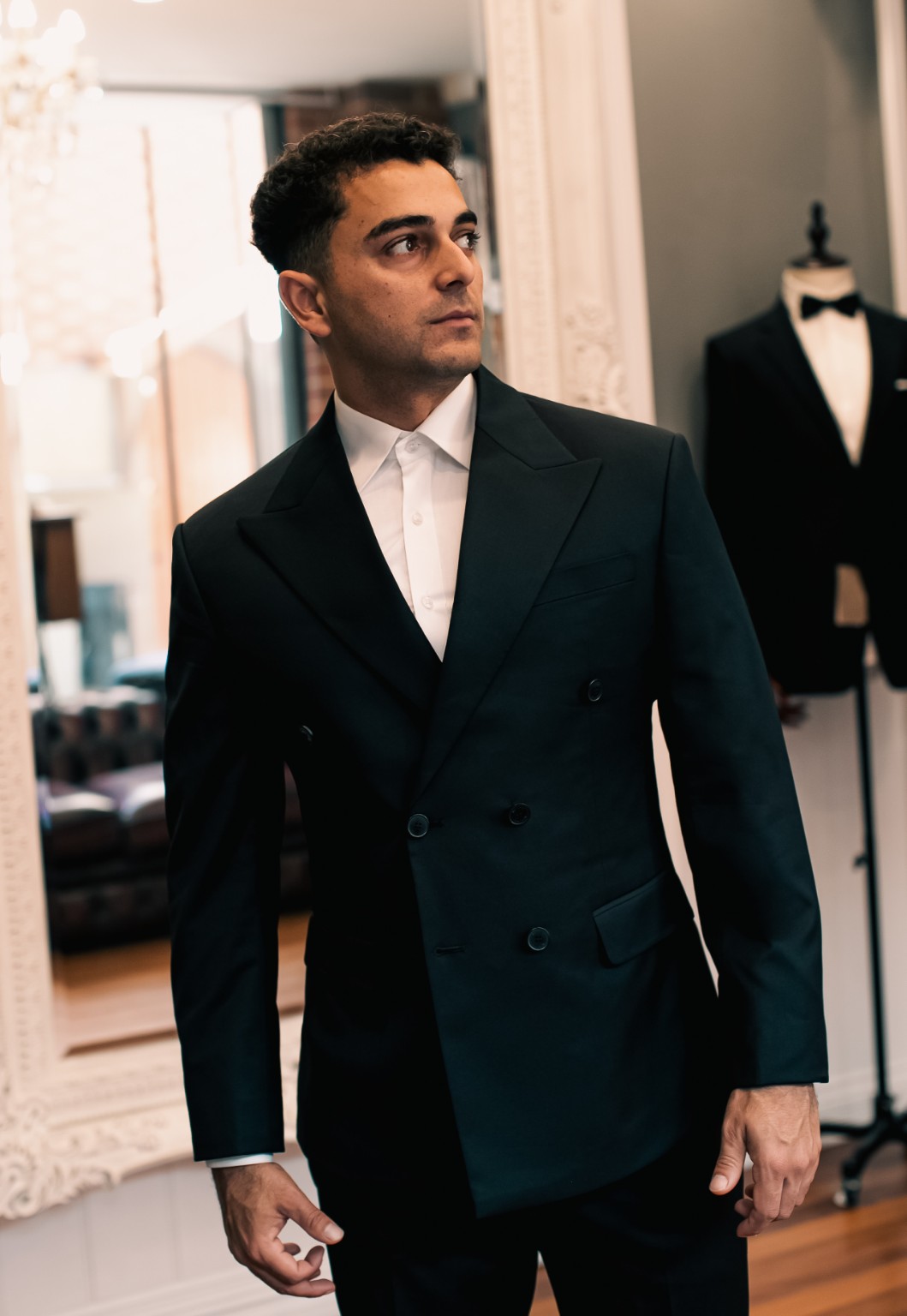
The gentleman in this photograph came to us for his first bespoke suit. He had a general idea of the style he wanted, but like most people commissioning their first suit, he didn't know all the technical details. Why would he? He's not a tailor.
He knew what appealed to him, and he trusted us to guide him through the rest. I remember telling him how grateful I was for that trust.
Mate, you show me what you're after, and leave the rest to me.
Now, I can imagine what some people might be thinking. That's a pretty confident thing to say, Tony. Well, perhaps. But I tend to underpromise.
I've always preferred letting the work do the talking. There are usually a couple of things I keep up my sleeve, not because I'm trying to be clever, but because I know what might be possible once I've studied the person, the cloth and the construction.
I don't want to promise somebody a miracle before I've even picked up the shears. I'd rather guide them through the process and let them discover the result for themselves.
This particular suit was one of those commissions where everything came together beautifully. The cloth, the lapels, the shoulder line, the chest, the waist, the overall proportions. Every decision had to work with the next.
Isn't that just the person who cuts the fabric?
Well, yes. And no. A cutter does physically cut the cloth. But that's only the part you can see.
Think about building a car. Somebody has to design the vehicle, determine its dimensions, its weight distribution, its suspension geometry and how everything works together. Then somebody has to manufacture and assemble those parts.
You wouldn't expect a beautifully painted car to handle properly if its underlying geometry was wrong. A suit is similar.
A coatmaker may sew a beautiful jacket. The pockets might be perfect. The seams might be beautifully finished. The buttonholes might be works of art. But if the garment was cut incorrectly in the first place, all that beautiful sewing won't necessarily make it sit correctly on the body.
The cutter determines the underlying architecture. We study the person's frame and develop the pattern that determines how the garment will be shaped.
That's not just taking measurements. Two gentlemen can have exactly the same chest and waist measurements and need two completely different patterns. One might have forward shoulders. Another might stand very upright. Their arms might naturally hang at different angles.
All those little differences matter. You can't simply take the numbers from a measuring tape and expect them to explain the whole person.
Learning to cut properly is such an advanced part of traditional tailoring because you're no longer learning one operation. You're learning how the entire garment works.
A few millimetres here. A little adjustment there.
Let's go back to our gentleman's suit. Look at the peak lapels. Now look at how they relate to the shoulder line and chest. Look at where the jacket narrows, how the double-breasted front sits and how the jacket length relates to his frame.
None of those decisions exists independently. If I change the lapel width, it can alter the visual relationship with the shoulder and chest. If I change the shoulder angle, it affects how we develop the upper part of the jacket.
If I adjust the front and back balance, I influence how the garment hangs. And if I distribute the ease differently through the chest and waist, I can change both the comfort and the silhouette.
You see, a suit isn't simply a collection of measurements stitched together. It's geometry. Three-dimensional geometry, wrapped around a human body that moves.
And people aren't symmetrical. That's the fun part. One shoulder might sit slightly lower. One side of the body might be more developed. Sometimes the technically correct pattern isn't perfectly symmetrical either. That's not a mistake. That's the cutter interpreting the individual.
For this suit, I worked through the lapel proportions, shoulder line, drape and balance carefully. Sometimes a tiny adjustment makes a remarkable difference.
And perhaps more importantly, understanding what happens elsewhere in the garment when you change them. That's the difference between following a pattern and knowing how to create one.
One person doesn't make an entire tailoring house.
Now, before anybody gets the wrong idea, I should explain something about our workshop. I'm often the person you see representing Perth Tailoring Co, but there's a whole family of tailors behind me.
And when I say family, I genuinely mean it. I'm one of the youngest people in the workshop. Some of our senior tailors were working here long before I came along.
I didn't inherit a position and suddenly become the person who knows everything. Quite the opposite. In our culture, these people are my uncles and aunties. That's how I see them, and that's the respect I have for them.
They don't need me standing over their shoulders telling them how to sew a jacket. We each have our responsibilities and specialisations, and I have enormous respect for the knowledge they bring to the workroom.
Although I suspect there are moments when they wonder how I manage to function at all. I'll be concentrating on a pattern, completely absorbed in what I'm doing. Then I'll put my shears down. Five seconds later: Where on earth did I put those scissors?
I'll start looking around the cutting table, moving things and checking under the cloth. Then I'll lose my measuring tape. Now the whole workshop is involved. And there it is. Around my neck. Exactly where I left it.
Honestly, sometimes I wonder about myself. The others just laugh. They've seen it all before.
But when there's work to be done, everybody knows their craft. Cutters, coatmakers, trouser makers, fitters and finishers bring different skills to the same commission.
At Perth Tailoring Co our showroom and working tailoring workshop operate together. We develop the pattern and cut the cloth here. Our tailors construct the garment. During fittings, we assess how it behaves on the customer's body. If the cut needs refining, those decisions return to our cutting table and workroom.
When the jacket goes on.
Now, this is probably my favourite part of the whole story. After all the cutting, sewing, fitting, correcting and finishing, there comes a moment when the garment is ready to go back onto the customer.
I don't care how many suits you've made. There's something about that moment.
I help him into the jacket. One arm through the sleeve. Then the other. I settle the garment over his shoulders, adjust the collar, straighten the fronts and make sure everything sits where it should.
And then I step back. Here's the funny thing. I'm usually watching the customer's face rather than the suit. Because I already know what we've been working towards. What I don't know is how he's going to react.
Sometimes there's a little silence. Sometimes a very long silence. And I'm standing there thinking, Oh God. I hope he likes it.
Then you see it. The eyes open a little wider. The mouth drops. He looks down at the jacket, looks back at the mirror, turns slightly and looks again.
Honestly, it's almost comical. I'm thinking, What? You didn't think we could do that? Of course, I don't say that. Well, not always.
Some clients shake my hand. Some give me a hug. Some just keep looking at themselves in the mirror.
For a few seconds, you're seeing somebody discover something about themselves. They're standing differently. They look comfortable, confident. After all these years, that reaction still means the world to me.
You can't learn to cut a bespoke suit from a sales brochure.
You can walk into a menswear shop and choose a beautiful fabric. You can select lapels, buttons, lining and other details. You might have your measurements taken and dimensions adjusted. There's nothing wrong with that. Made-to-measure and other custom clothing systems have their place.
But selecting options from an established pattern system isn't the same as having a cutter develop an individual bespoke pattern around your body.
The difference is the technical freedom available, and the knowledge of the people making the decisions.
A salesperson may be very good at helping you choose a style. But can they explain why your jacket is pulling across the back? Can they determine whether the problem is connected to shoulder position, balance or the underlying cut?
Can they change the pattern? Do they understand how that adjustment affects the rest of the garment? And can the people responsible actually carry out the work?
At Perth Tailoring Co, you're working with people who know how to create the garment. People who work with needles, shears, chalk, patterns and cloth every day.
Tony, you made my suit twenty years ago!
Something rather wonderful happens when you've spent a lifetime in this trade. Every now and then, I'll be somewhere completely unexpected. Down south, in Sydney, walking through a shopping centre. And somebody will come up to me.
Tony! Is that you? I'll say, Yeah, mate. How are you? Then they'll tell me I made their wedding suit fifteen or twenty years ago.
Now, here's my confession. Sometimes I can't remember who they are. We've made a lot of garments over the years. But they remember.
They'll tell me about the suit. The wedding. How they felt wearing it. Sometimes they'll tell me they've still got it. And they'll thank me.
But I always think the same thing. No, mate. Thank you.
Thank you for trusting us. Thank you for inviting us into one of the important moments in your life.
Because when somebody commissions a suit for their wedding or another special occasion, we're being invited into a memory. They may wear the suit for one particular day, but that day might remain important to them for the rest of their life.
You already know the destination.
I sometimes think people misunderstand what a bespoke tailor is supposed to do. They imagine somebody telling them what looks good, what to wear and which style is fashionable.
But that's not how I see my job. You bring your own taste, personality and ideas. Sometimes you have a clear picture. Sometimes it's just a vague feeling. That's fine.
You don't need to know how to describe every technical detail. That's where we come in.
We guide you towards cloth that will behave the way your intended garment needs it to behave. We develop the pattern around your body. We determine the proportions, structure, balance and silhouette. Then we cut, construct, fit and refine the garment with you.
It's a collaboration. You're the person who knows where you want to go. We have spent our lives learning how to make that journey possible.
I started this story by telling you that I'm more comfortable at the cutting table than behind a microphone. That's still true. When the chalk comes out and the shears are in my hands, everything else seems to disappear.
After all these years, I still find it remarkable that a conversation, a piece of cloth and a little trust can become something a person remembers decades later.
And behind each of those memories is our team, whose hands and experience helped bring it to life.
We cut here. We sew here. We fit here. And most importantly, we work with you.
Anthony Van Pham
Perth Tailoring Co · Established 1982