
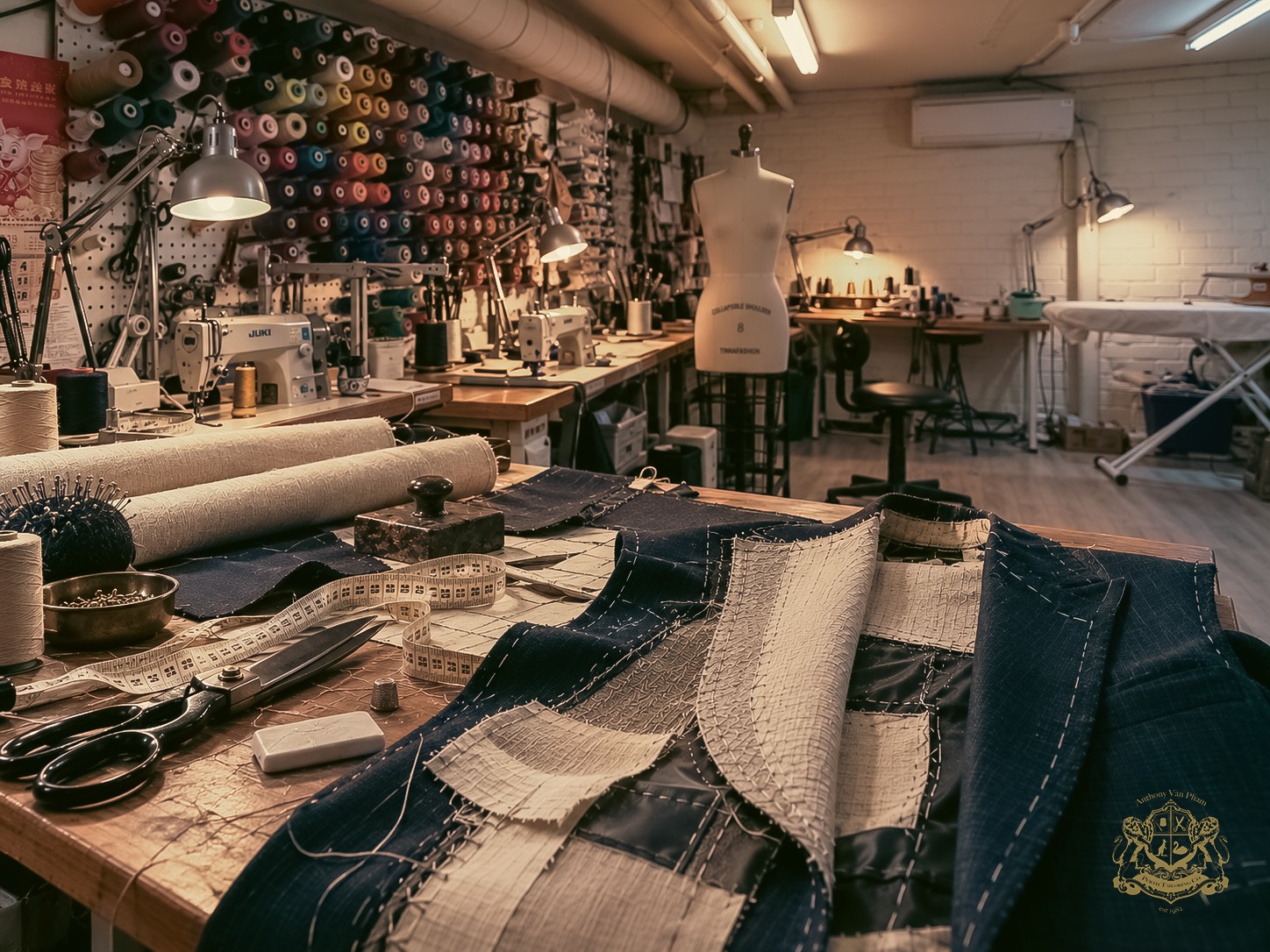
There's a question I hear quite regularly in our tailoring studio.
“Anthony, is it full canvas?”
It's a fair question. You've probably heard that full canvas is the best construction you can buy. Perhaps a salesperson has told you that it's more expensive, more traditional or simply better.
But here's something I find rather interesting. People spend hours researching whether a suit is full canvas or half canvas, yet rarely ask what sort of canvas is actually being used. Or who's choosing it.
And believe me, those are far more important questions.
What does canvas actually do?
Inside a tailored jacket, between the outer cloth and the lining, you'll find materials that help support and shape the garment. Canvas is one of the most important.
It contributes to the shape of the chest, supports the lapel, influences how the jacket holds its structure and helps determine how the cloth behaves when worn.
There isn't just one type of canvas.
There are different materials, weights, densities, levels of stiffness and combinations of supporting layers. Traditional construction may involve linen-based canvas, horsehair-containing haircloth and other supporting materials.
Some are soft and flexible. Others have considerably more firmness and spring. The choice depends on what the tailor is trying to achieve.
A lightweight summer jacket doesn't necessarily require the same internal construction as a structured business suit. And even two suits made from similar cloth may need different approaches because the people wearing them have different bodies.
Full canvas, half canvas and fused construction
Let's clear up the terminology.
Full canvas generally means a floating canvas structure extending through the jacket front, from the upper chest towards the hem.
Half canvas generally means a floating canvas through the chest and lapel area, with the lower front commonly supported by fused interlining.
Fused construction uses interlining bonded to the outer cloth with heat and adhesive.
All three are construction methods. A properly made full-canvas jacket can offer excellent shaping and flexibility. Half canvas can provide very good chest structure with less construction complexity. Fused construction can be appropriate for particular garments and production methods.
But those descriptions don't tell you which materials were selected, how they were shaped or whether the internal structure actually suits your body and cloth.
Would you put a V8 in every car?
Imagine walking into a dealership looking for an economical delivery vehicle. The salesperson tells you to buy a V8.
You ask why. “Because it's better. More powerful. More expensive. And if you ever need the extra performance, it's there.”
Wonderful. But you're doing deliveries all day, burning fuel unnecessarily and carrying an engine you don't need.
Wouldn't it make more sense to ask what you're actually using the vehicle for?
Now imagine you wanted an electric car and the salesperson recommended a V8 instead, just in case. You'd probably wonder whether they understood your requirements at all.
Well, canvassing works on a similar principle.
A heavier or more extensive internal structure isn't automatically better simply because there's more of it. A soft, lightweight cloth may require a different canvas from a heavier fabric. A customer wanting a relaxed silhouette may need a different approach from someone wanting a strongly defined chest.
And the shape of the person's shoulders, chest and posture can influence how that construction needs to be developed.
Selecting canvas is not the same as tailoring it
This is where having a practising tailor becomes important.
When someone commissions a bespoke suit at Perth Tailoring Co, we begin by understanding the person: their proportions, posture, shoulder position and the silhouette they're trying to achieve.
Then we consider the cloth they've chosen. Its weight, weave, drape and natural behaviour all influence the construction.
From there, the cutter determines which canvas materials, weights, stiffness and supporting layers are appropriate.
And here's something people often overlook. The canvas isn't simply taken from a shelf and placed into the jacket unchanged. It must be cut, shaped and worked into the garment.
That requires technical experience. A salesperson may be able to offer full canvas as an option on an order form. But selecting a construction option isn't the same as knowing how to construct it.
It's rather like selling a high-performance engine without understanding how to build the car around it. You can learn the terminology, memorise the specifications and explain the theory. But that doesn't mean you possess the practical skills to carry out the work.
Tailoring is a trade. The difference between describing a process and performing it is considerable.
You're speaking to the person who makes it
At Perth Tailoring Co, traditional bespoke tailoring is carried out in our own Perth premises. Our showroom and working tailoring workshop operate together.
We cut the cloth here. We select and shape the canvas here. We construct the garment here. And we bring the developing garment back onto the customer through basted fittings so the cutter can assess and refine its shape directly.
Based on our more than four decades of experience in the Western Australian tailoring trade, PTC is the last remaining tailoring studio in WA providing this complete traditional bespoke process in-house, with the cutter, workshop and customer working together under one roof.
That's an important distinction. You're not simply choosing from a predetermined range of construction options. The garment is being developed for you, and the canvas is part of that individual construction.
And when you come in to talk about it, you're not asking a salesperson to find out what someone else will do. You're having a conversation with the tailor who will actually work on your garment.
So, which canvas is best?
Well, that's something we determine together.
We discuss your body, the cloth you've chosen, how you'll wear the garment and the silhouette you're trying to achieve. Then we work out the structure needed to get there.
We're not asking you to pick a canvas from a catalogue and hoping it suits you. The garment doesn't exist yet. We're going to make it for you.
And that's what makes the conversation different. When you ask who chooses the canvas, the person standing in front of you is the one doing the work.
At Perth Tailoring Co, bespoke tailoring isn't simply something we sell. It's something we do.
We don't just sell suits here. We sew them.
Anthony Van Pham
Perth Tailoring Co · Established 1982